

Among all the precious stones, turquoise is certainly the best known and most fashionable stone currently due to its very particular color which can vary from light blue to intense green.
The turquoise stone is symbolic for humanity, since it has been exploited by man for 6000 years, it has fascinated all civilizations that have had the opportunity to extract it from the ground.
It has been found for millennia, used by Chinese dynasties, the Persians, the pharaohs of Egypt and the Aztecs.
All these civilizations attributed magical powers and mystical significance to it, so much so that the turquoise stone was used almost everywhere as a ceremonial ornament, amulet, healing stone or as offerings to rulers.
Examples of ancient jewelry using turquoise, on the left, a Persian gold ring, in the center an Egyptian breastplate inlaid with turquoise and on the right an Aztec wooden mask inlaid with natural turquoise. You will discover more Persian turquoise jewelry on this page.
Considered since ancient times as a precious stone (it is a precious stone in the modern sense), man has tried to imitate it for centuries.
However, even though man’s relationship with the turquoise stone dates back thousands of years, it is a stone that still retains some mysteries and is still studied by scientists to better understand its formation mechanism and to differentiate real turquoise from its imitations.
 |
 |
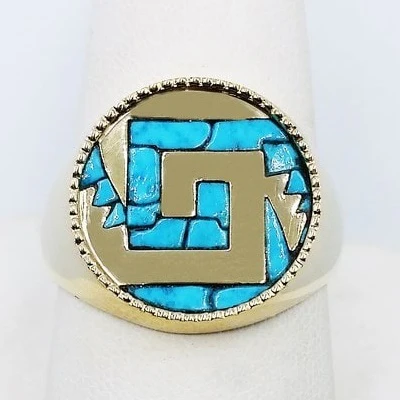
Mixtec style signet ring with natural turquoise stones
The turquoise blue color is the most sought after. We can clearly see, in this photo, the imperfections of the natural stone, the veins of the turquoise as well as the variations in the shades of the green of the stone.
The different names of turquoise depending on the civilizations
Called «Important«from the ancient Egyptians»,Callis«from the Romans»,Firouze«from the Persians and»Teoxihuitl«from the Aztecs.
The Western Name»turquoise«, which literally means Turkish stone, is due to the Crusaders who brought these stones back from the Crusades.
These stones were not mined in Türkiye, but in Persia, Turkey then was just a center for the exchange of stones from Persia.
Composition and formation of the gem
Turquoise is a porous, friable and hydrated mineral, of a variable blue-green colour, a color that varies depending on the chemical composition of the stone, which in turn varies depending on the nature of the soil that gave rise to its formation.
Chemically, turquoise»is a hydrated phosphate of aluminum and copper containing significant proportions of iron whose formula is CuAl6 (OH)8 (PO4)4 -4H2O«.
Concretely, turquoise is composed of approximately 10% copper, 37% Al2O3, 35% P2O5 and 17% water (variable content because the stone can dehydrate) and iron ions (Fe2+ and Fe3+).
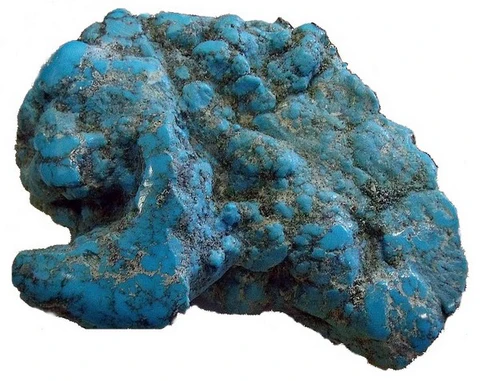
Large rough Mexican turquoise stone mined from the Cananea copper mine in the state of Sonora in northern Mexico.
Natural formation
Turquoise is the result of the slow action of acidic waters on copper minerals or on aluminous rocks (containing aluminium), due to the oxidation of minerals already present in the ground.
It forms at the surface (generally less than 20 m depth) and is generally found on the surface of copper ore deposits.
It is most often found in volcanic or sedimentary soils containing aluminous rocks and located in arid regions (see the map below in the article).
Property
Turquoise, due to its variable composition, has a density that varies from 2.6 to 2.85 and a hardness that varies from 5 to 6 on the Moh scale.
It dissolves in hydrochloric acid and its porosity makes it sensitive to fatty acids (perfumes) and sweat (jewelry in contact with the skin) which can alter its color.
Its brittle structure makes it difficult to work when it is pitted to be mounted on a jewel.
Understand the origin of the colors taken on by the turquoise stone
The color of the stone is due to the presence of copper ions and iron ions (Cu2+ and Fe3+). Because copper ions absorb the orange to red light spectrum, they favor blue and green wavelengths.
Fe3+ ions absorb blue/violet wavelengths, giving the stone a green tint.
«Variations in the concentration of Cu2+ and Fe3+ ions produce the color range of turquoise which varies from blue to malachite green.
So much so that the nature of the soil directly influences the color and appearance of turquoise. We could therefore in theory have a good idea of the provenance of a stone based on its appearance, a sort of fingerprint of the soil that gave birth to it. Not to mention the imitations of turquoise.

Example of colors of natural turquoise stones
Photo showing the wide range of colors that turquoise stones can take on, from deep green to light blue. It should also be noted that the presence of veins varies greatly depending on the stone.
Color change from blue to turquoise green
The color of the stone depends on its chemical composition, which is influenced by the stone’s contact with chemicals.
Due to the natural porosity of the stone, it is profoundly affected by acids present in perfumes, body creams or even sweat.
The action of these liquids can interfere with the chemical composition of the stone and therefore lead to a change in its color.
Since turquoise is a hydrated stone, it is also not recommended to leave it exposed to the sun, as dehydration of the stone can lead to a change in color.
Although the stone has been used for millennia, the color-changing mechanism of turquoise is still poorly understood. Scientists believe that under the action of chemicals, Fe2+ ions transform into the Fe3+ state, thereby absorbing blue/violet wavelengths, thus making the stone green.
Turquoise mining worldwide

The main producing countries of turquoise stones are China and the United States.
This precious stone is also mined to a lesser extent in Iran, Afghanistan, Uzbekistan, Tajikistan, Turkey, the Sinai Desert, Peru, Chile, Brazil, Mexico, Ethiopia, India and Australia.
While China is a large producer of turquoise in terms of volume, the United States and Iran (Nichapur and Kerman deposits) are the countries most renowned for the quality of their turquoise.
You can find more information on American turquoise mines (the states of Nevada, Colorado, Arizona and New Mexico) by visiting this site.
This map will already give you a first overview of the distribution of American mines, which in the past were located in Mexican territory and were already exploited by pre-Columbian populations (Hopi Indians of Arizona, Apaches, Zunis of New Mexico).

Turquoise stone mining in the United States
This map shows the four major turquoise producing states in the United States. There are also some mines in California and Utah. This site will give you more information about the location of mines in these regions.
Real, treated, synthetic and imitation turquoises
It must be admitted that recognizing natural turquoise and related treatments is a real headache for gemologists since there are so many techniques to improve, modify or imitate turquoise.
In this chapter we introduce you to these different types of stones, but know that to analyze the composition of turquoise, scientists use heavy equipment to carry out a spectrometric analysis and study the stone’s X-ray diffraction.
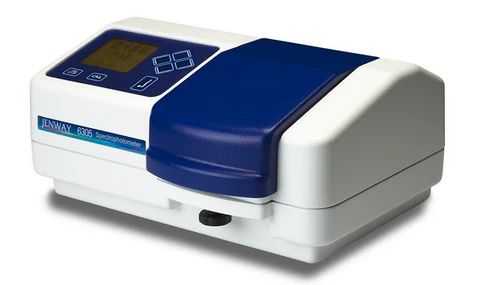
Spectrophotometer used to analyze the absorbance of turquoise samples at wavelengths of light. Measuring this absorbance allows you to determine the material that makes up the sample.
Real treated turquoise
Due to its fragility and porosity, turquoise is often impregnated with resin which will mechanically strengthen it making it easier to stone and will help stabilize its color making it less sensitive to chemicals.
These stones are found under the name “stabilized” or “impregnated” turquoise.
A simple technique to recognize such turquoise is to prick it with a hot needle to see if it sinks into the stone, thus certifying a resin treatment of the stone.
Pyrite encrustation in turquoise is common; this impurity guarantees that the stone is neither reconstituted nor synthetic.
The photo below shows a pyrite inlay in the stone set on a silver pendant.

Detail of a pyrite set in this natural turquoise
Reconstituted turquoise
It is made up of pulverized natural turquoise residues then agglomerated with resin. The needle test allows you to recognize them.
Please note that I don’t know how to distinguish with this test between a real treated turquoise and a reconstituted turquoise.
If you know where to find the information, your help will be appreciated.
Synthetic turquoise
The only process currently known for producing turquoise in the laboratory: the Gilson process, named after its inventor.
It allows you to obtain all shades from blue to green to turquoise, with or without veins. They are difficult to recognize, even under a microscope.
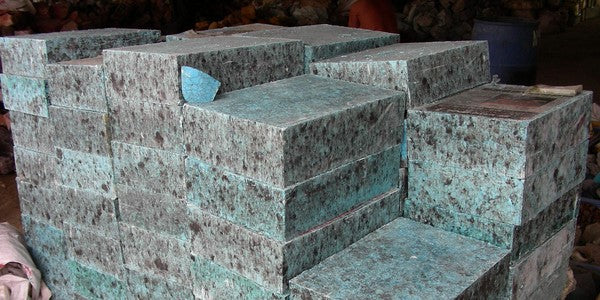
Blocks of synthetic turquoise in a Chinese factory
The following video shows the blowtorch test of a natural truquoise stone and a synthetic turquoise:
The imitations
If in its natural state no mineral has a color that comes close to that of turquoise, there are however some minerals that have a very similar appearance and, when coloured, can easily be confused with natural turquoise.
The most frequently used minerals are: calcite, magnesite, dolomite, howlite and gibbsite.
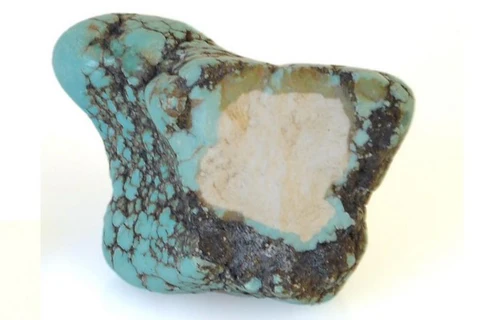
Sectional view of a howlite, a natural stone, colored in the mass to imitate turquoise.
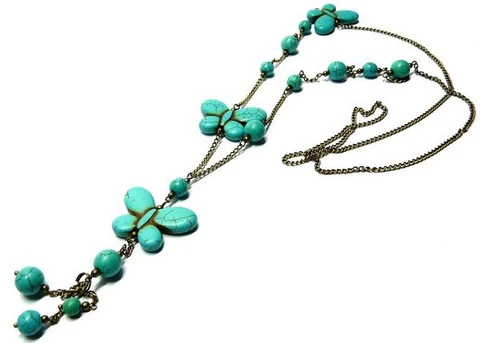
Howlite is certainly the best known of all these materials and is sold commercially as an imitation turquoise stone, particularly to make perforated beads used to assemble jewelry, as in the case of this necklace.
Turquoise in jewelry: stoning and polishing
Turquoise is a precious stone much appreciated by the public and frequently used in jewelery to be set on rings or as pendants.
One can well imagine that commercial turquoise jewelery is made with synthetic or imitation stones, on the one hand for cost reasons, but also because it would be impossible to reproduce two identical models of the same jewel with natural turquoise whose shade and veining change from one stone to another.
Real turquoise stones are therefore mainly used for the creation of personalized jewelery for which the customer can choose their own stone according to their tastes.
It is worth pointing out that this procedure involves a «waste» of material since, starting from a turquoise whose shade and veining matrix correspond to the customer’s tastes, it will then have to be cut and polished in order to be able to mount it on the jewel.
It is normal to lose 30 to 50% of the stone during this stoning phase.
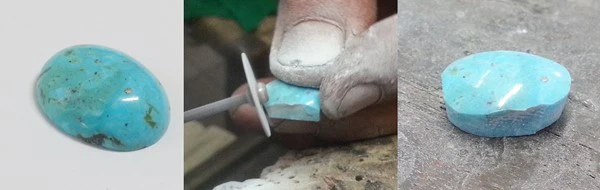
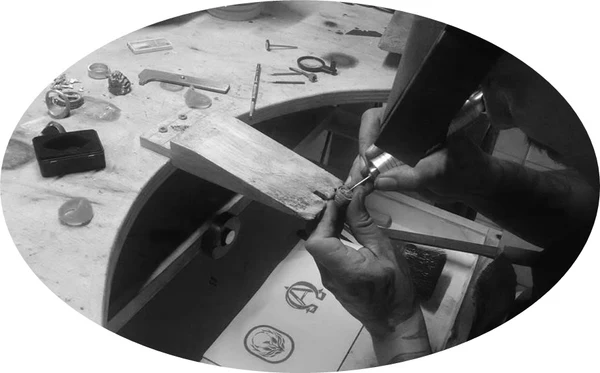
Stonework of a turquoise cabochon with diamond disc
Source:
Main scientific source: DUG memoir by Mrs Claire Salanne on turquoise stone and its imitations
Photo source for imitation and fake turquoises: rings and things
To go further:
latest posts published

Moonstone in jewelry

Engraving of men’s signet rings
Diamond clarity: inventory of natural inclusions

Creation of a Chrisme Medal in 18K Gold

18k gold men’s necklace (handcrafted)
Recycle 800 silver into pure silver

Large 18k solid gold bracelet

18k gold chain pendant

the history and symbols behind the Mo signet ring
