
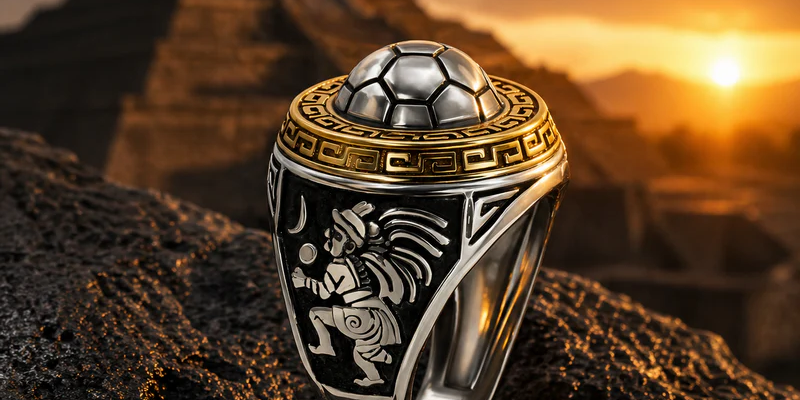
The MEXICA RING was born from a simple desire: to create a true commemorative ring for the 2026 World Cup capable of linking the passion for football to Mexican culture as well as to the Mesoamerican sporting and sacred heritage.
Unlike rings traditionally created for players or competition winners, this project was designed especially for football fans. For those who experience a World Cup as a moment of remembrance, transmission and collective emotion.
The MEXICA RING design connects the 2026 FIFA World Cup in Mexico with the heritage of sport that has been ritualized for over 3,500 years
The MEXICA RING was imagined as a bridge between two universes.
Between contemporary football and the ancient rituals of the Mesoamerican ball game.
Between the 2026 World Cup and Mexico’s cultural heritage.
But this creation is also the fruit of a reflection that began several years earlier, during the 2022 World Cup in Qatar.
INDEX
- The birth of the project
- The ball in the center of the MEXICA ring
-
A Mesoamerican inspiration
- A limited edition of 970 copies
- More than a ring, an object of transmission
1. The birth of the project
Long before the 2026 World Cup was in the news, I had the opportunity to work on designing a commemorative ring for the FIFA World Cup in Qatar in 2022. The entire QATAR 2022 RING project is presented in this article.
In summary, after France’s victory in the 2018 Cup, the players of the French team had a commemorative ring made to celebrate their world title. This ring was made by a Los Angeles jewelry company with an aesthetic very inspired by North American championship rings.
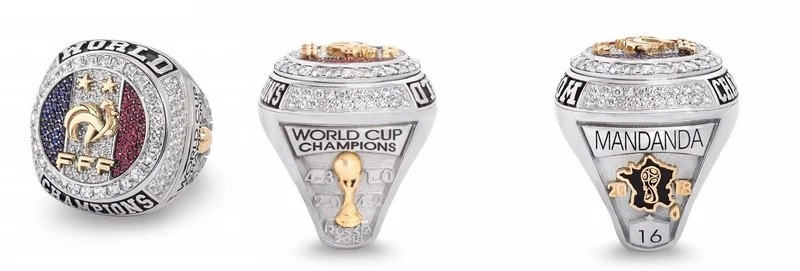
Ring commemorating the victory of the French team during the 2018 World Cup
Analysis of the design of this ring and comments from football fans allowed us to make several observations:
- a design very inspired by the codes of the American championships, but with few direct references to the world of football;
- the absence of the most symbolic element of this sport: football;
- an accumulation of visual elements that give the whole a very lively aesthetic
Based on this observation I tried to create a commemorative ring for the 2022 World Cup with the following specifications:
- bring the soccer ball back to the center of the drawing;
- offer a cleaner and more readable aesthetic;
- designs a ring designed especially for football fans
Commemorative ring of the 2022 World Cup which will take place in Qatar
This ring is composed of a soccer ball-shaped ring with added elements in 18k yellow gold: the map of Qatar, the 2022 World Cup and the upper circle with the writing FIFA World Cup Qatar 2022.
The results of this first creative experience were also very instructive:
- a ring entirely inspired by the structure of a balloon imposes a visually relatively imposing ring;
- elements added in gold significantly increase the manufacturing cost and lose legibility when made in silver
From this first experience an idea became central: to create a ring designed not for the players or winners, but for the fans and football enthusiasts.
This is the first reflection around the QATAR RING 2022in turn born after the discovery of the 2018 world champions ring project, which progressively led to the creation of the MEXICAN RING.
This new creation no longer just sought to represent modern football, but to connect the memory of a World Cup to a deeper cultural, historical and symbolic dimension around Mexico and the Mesoamerican ball game.
2. The ball in the center of the MEXICA ring
For this project I wanted to once again place the soccer ball at the center of the ring design, avoiding repeating the principle of the ring entirely inspired by a ball used during the project QATAR 2022.
Finally, it was decided to place the ball in the center of the signet ring, surrounded by a disc engraved with motifs inspired by the Mayan Greeks.
Why this choice?
If you have taken the time to consult our dedicated factsheet on the 2026 World Cup in Mexico, you have undoubtedly discovered the history of the Mesoamerican ball game and the cultural heritage of this ancient ritual sport practiced throughout much of Central America more than 3,500 years ago.
The ring surrounding the ball is directly inspired by the scoring rings found on some Mesoamerican playgrounds. These stone elements, often engraved with religious and spiritual symbols, occupied an important place in the rituals linked to this sacred sporting practice.
The goal was to create a simple visual connection between contemporary soccer and the legacy of the Mesoamerican ball game, considered one of the oldest team sports in human history.
The ball thus becomes the central point of the composition, while the engraved disc evokes ceremonial motifs, cycles, movement and Mesoamerican cultural transmission between generations.
The engravings were made in intaglio to create greater visual depth and allow a natural contrast between the polished areas, the oxidized silver and the versions that combine solid silver and yellow gold.
Views of the MEXICA ring tray in these two versions, silver and silver & yellow gold
3. A Mesoamerican inspiration for the engravings
The engravings on the sides of the MEXICA RING draw inspiration from the visual and symbolic universe of Mesoamerican civilizations.
Designed around the 2026 World Cup in Mexico, the ring combines the codes of contemporary football with the legacy of the ball game played on Mexican soil for several millennia.
The ball player
On one side appears a Mayan ball player with a rubber ball, accompanied by traditional protections and a headdress inspired by pre-Hispanic representations.
Above the character, a crescent moon evokes the ritual and cosmological dimension associated with the ball game in Mesoamerican cultures.
This scene is a discreet reference to the ancient origins of team sport on Mexican territory.
Mexico 2026
The words “Mexico 2026” anchor the ring to a historic edition of the World Cup while maintaining a sober and balanced design.
Integrated directly into the sides of the signet ring, this inscription serves as a temporal marker, transforming the MEXICA RING into a commemorative object tied to a specific moment in football history.
Views of the engravings on the sides of the MEXICA RING
The Mesoamerican spiral
The geometric pattern on the sides of the ring is inspired by the spirals and architectural shapes seen in Mesoamerican art.
Combining spiral and scale, this symbol evokes notions of cycle, continuity and progression, recalling the monumental lines of pre-Hispanic pyramids and temples.
Through these carvings, the MEXICA RING seeks less to illustrate than to suggest a dialogue between cultural memory, Mexican heritage and passion for football.
4. A limited edition of 970 copies
From the beginning of the project, the MEXICA RING was not designed as a product intended to be manufactured in large quantities.
On the contrary, the objective was to create a rare commemorative object, directly linked to a historic edition of the World Cup and the particular emotion it will represent for football and Mexico fans.
The MEXICA RING will therefore be produced in a limited edition of 970 numbered pieces, the number of 970 directly referring to the date of the first World Cup hosted by Mexico in 1970.
This choice allows us to preserve the symbolic and collectible dimension of the project. Like commemorative objects linked to major historical or sporting events, this ring was designed to retain a strong emotional value over time.
5. More than a ring, an object of transmission
From the beginning of this project, the goal was never to create a simple jewel around the 2026 World Cup.
THE MEXICA RING was conceived as an object capable of preserving the memory of a historical event while at the same time telling something bigger than football itself: the link between civilisation, collective rituals, popular passion and transmission between generations.
Through its design, its engravings and its references to the Mesoamerican ball game, this ring seeks to connect a modern sporting event to a much older cultural history, present in Mexican territory for several millennia.
The 2026 World Cup will be a unique moment for millions of fans around the world. Some will travel to Mexico, discover its stadiums, its cities, its culture and experience memories that will remain associated with this competition for a lifetime.
The MEXICA RING was imagined as a way to materialize this memory.
Not as a trophy reserved for winners, but as an object intended for football fans, for those who see a World Cup as much more than a simple sporting competition.
Over time, this ring will perhaps become the memory of a trip, of a match, of an emotion shared between friends or family. It is this idea of transmission and collective memory that guided the creation of BAGUE MEXICA from the first sketches of the project.
About the author:
Nicolas Tranchant is French, naturalized Mexican since 2018, and has lived in Mexico for more than fourteen years. An engineer by training, married to a Mexican since 2011, he manages the online jewelry company Vivalatina in Puerto Vallarta (Jalisco). His analysis of Mexico is based on long-term field experience, nourished by sustained personal and professional immersion.
latest posts published

Moonstone in jewelry

Engraving of men’s signet rings
Diamond clarity: inventory of natural inclusions

Creation of a Chrisme Medal in 18K Gold

18k gold men’s necklace (handcrafted)

Large 18k solid gold bracelet

18k gold chain pendant

the history and symbols behind the Mo signet ring

Rolex: a brand that has become essential
