
purity, also called diamond clarityit is with its color a difficult criterion to appreciate for non-gemologists.
This is a comparative criterion for classifying diamonds based on the number and size of the inclusions (various impurities) present in the heart of the crystal and the surface defects of the precious stone. This is one of the 4 criteria for evaluating the quality of white diamonds.
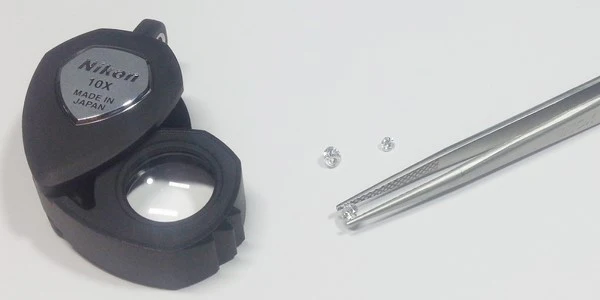
The clarity index is assessed by a gemologist with a x10 magnifying glass, analyzing the diamond under cold light (typically LED) with the diamond held by tweezers against a white background.
A 10x magnifying glass, tweezers, a white background and cold light are essential to appreciate the clarity of a diamond.
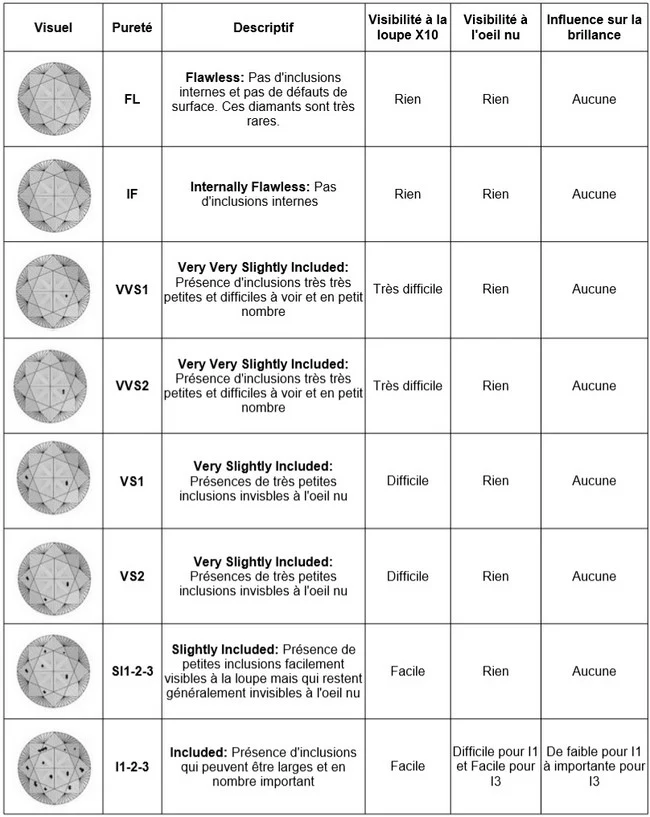
Diamond clarity grading scale
The following table shows how diamonds are classified based on the number and size of impurities they have. Summarizing this table, the more the impurities are visible, the more the purity of the diamond will be devalued.
The different types of diamond imperfections
There are many types of inclusions and surface imperfections that a diamond can present, here they are presented in English, as this is how you will find them on the quality report of your diamond or on the certificate drawn up by a gemological laboratory:
- Crystal: presence of a mineral deposit in the heart of the diamond generally seen dark or black
- Punctuform: presence of a very small crystal often perceived as whitish in color
- Cloud: presence of a tight grouping of small crystals not visible individually
- Cavity: presence of a depression on the surface of the diamond
- Chip: presence of a chip on the surface of the diamond, most often caused during cutting
- Bruise: presence of a chip on the surface of the diamond which very often implies a fracture of the crystal as its origin
- Feather: presence of a fracture from which thin lines branch out, reminiscent of the design of a feather
- Needle: presence of a line-shaped fracture (like a needle)
- Twin tuft: presence of a flat ribbon of small crystals caused by the natural distortion of the crystal
- Natural: presence on the surface of a small portion of rough unpolished diamond, generally present in correspondence with the belt
- Natural serrated: presence of a Natural type defect which causes a small cavity on the surface
- Extra Facet: presence of an additional facet that does not fall within the cut standard of the diamond considered
To concretely visualize these defects, consult the interactive diagram on this page.
Treatments to improve the clarity of diamonds
Since the price of a diamond depends heavily on its degree of clarity and since almost all diamonds have surface imperfections or inclusions, various techniques have been developed to eliminate these defects or make them less visible.
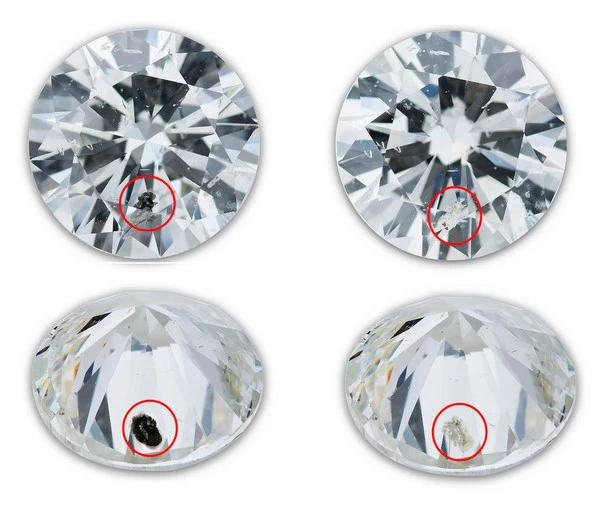
Photo showing a diamond with inclusions before laser treatment and then after treatment (photo source)
- Acid treatment: the diamonds are immersed in an acid bath which does not attack the crystalline lattice of the carbon but dissolves all the impurities and crystals present on its surface. This operation is very common and cheap.
- Laser drilling: this technique is used when the imperfections of the diamond are inside the crystal lattice and inaccessible from the outside. We use a laser that will drill into the diamond, creating a channel from the surface to the imperfection. If the blemish was a crystal, it can now be treated with acid to make it disappear. The hollow cavity is therefore much less visible than the dark crystal previously present.
- Fracture filling: This technique is used following laser drilling, when the acid-treated crystal has disappeared and left a cavity within the diamond. A special compound is then injected into the cavity which will prevent light from reflecting on the walls of this cavity. The cavity is therefore still present, but made almost invisible. This technique was developed by Yehuda from the Yehuda Diamonds company.

Photo showing the result of laser drilling used to eliminate a foreign crystal within the diamond (photo source).
If the first two techniques for improving the clarity of diamonds are tolerated by the GIA, the situation is very different when it comes to filling fractures. This institute refuses to certify such diamonds. It should be noted that other laboratories do this, specifying in the comments on the certificate that the clarity of the diamond has been improved.
Attention, one should not think that diamonds treated in this way are of poor quality, on the contrary, they are natural diamonds that offer a beautiful finish at a lower price, so this can be a good option if you are looking for a fairly large diamond at an affordable price because they are less expensive than diamonds of equivalent clarity of course.
In any case, it will be necessary to contact a gemologist or choose a certified diamond to find out what it is.
To go further:
latest posts published

Moonstone in jewelry

Engraving of men’s signet rings
Diamond clarity: inventory of natural inclusions

Creation of a Chrisme Medal in 18K Gold

18k gold men’s necklace (handcrafted)
Recycle 800 silver into pure silver

Large 18k solid gold bracelet

18k gold chain pendant

the history and symbols behind the Mo signet ring
