
Tanzanite stone is not a gemstone under French law.Caise, which considers only diamond, sapphire, ruby and emerald as such.
However, the price of tanzanite stone makes it a gemstone in its own right:
- it is rare in a geological sense (1000 times rarer than diamond)
- features exceptional blue/purple colors
- it is in great demand in jewelry
- there is already talk of the closure date of the only productive mine
To better understand the fascinating history of this stone we suggest you delve deeper into the origins of its discovery.
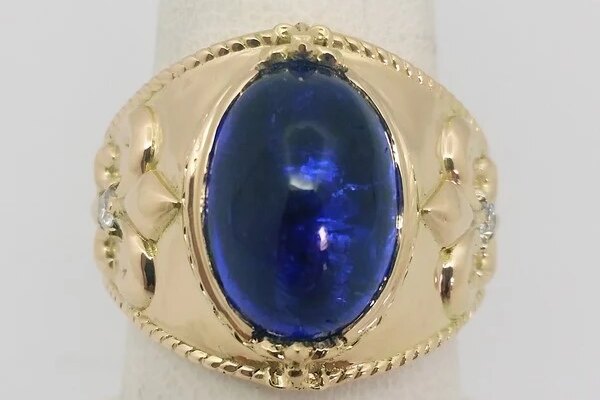
18k gold tanzanite ring whose manufacturing details are visible here
INDEX
1. History and origins of Tanzanite
2. The price of tanzanite
3. The Tanzanite brute
4. Tanzanite color
5. Stone maintenance
History and origins of the tanzanite stone
Tanzanite is in fact a zoist stone with a very particular composition, containing a high percentage of vanadium.
The stone is brown in color which turns to deep blue when heated to around 600°C for 30 minutes.
The Zoïstes variety was already well known to gemologists since their discovery by Sigmund Zoïs before 1805.
Zoïstes were then worthless silicates on the jewelry market.
The discovery
Tanzanite was discovered only in 1967 by the Masai on their territory following a forest fire that devastated the savannah and heated the local vanadium-rich zoïste stones sufficiently to give them an exceptional blue hue.
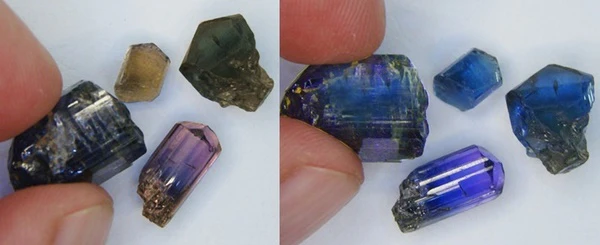
Examples of raw tanzanite stones before and after heating to accentuate the color by oxidizing the vanadium atoms.
These stones emerging from the ground cleared of bushes attracted the attention of the Masai who had them examined by gemologists.
This variety of Zoist, previously unknown, was called Tanzanite, in homage to the stone’s land of origin in Tanzania, by the New York jeweler Tiffany who fell in love with it.
We can say that the fame of Tanzanite largely depends on the efforts of the Tiffany house in promoting it.
Since Tanzania is not necessarily well known, I have prepared a brief graphic summary of its location in Africa:
The position of Tanzania in Africa
The only known and operated mine in the world is located in northern Tanzania, in the Merelany Hills, at the foot of Mount Kilimanjaro.
You can see the location of the tanzanite mine in the north of the country, southeast of the city of Arusha in this satellite view:
Satellite view of the mine in the north of the country (click on the image to enlarge)
The area of stone exploitation is only about twenty km2, as shown in this view from above.
View from the plane of the tanzanite mine site
From the mining site it is therefore possible to see the peaks of Kilimanjaro.
Mount Kilimanjaro looms on the horizon, seen from the tanzanite mine (source)
The tanzanite trade today
It should be noted that tanzanite is 1000 times rarer than diamonds and that the estimated reserves amount to only 105 million carats (i.e. only 21 tons), which makes it possible to estimate that the mine will dry up in about thirty years (at the current rate of exploitation and based on the resources known so far). (source)
The tanzanite business is 95% owned by the Masai as the deposit is on their land.
Many have made fortunes thanks to the dividends generated by exploiting this windfall.
Most production of raw tanzanites was historically cut in Jaipur, India, which is a world center for cutting fine stones.
Small raw tanzanite stones
But a law passed in 2010, The Mining Act, has since banned the export of rough tanzanite stones weighing more than 1 gram (i.e. 5 carats) in order to develop a Tanzania-specific economic fine stone cutting business.
This measure aims to increase the revenue generated by mining in the country.
If it initially concerns tanzanite stones, in the future it will be extended to other rough stones (sapphires, etc.) exploited in Tanzania.
Tanzanite mining generates 14,000 direct jobs in the local economy (source).
To discover the steps of cutting a tanzanite I invite you to watch this video:
The price of tanzanite
As you can imagine, the price of a Tanzanite stone will depend on the color of the stone, the intensity of this color, the weight of the stone and the cut quality of the latter.
Unfortunately, there is no standard system for classifying the quality of tanzanites.
Unlike the diamond which has it and whose price per carat is set on the international market.
Thus the GIA, a world-wide reference gemological laboratory, specifies in these appraisals only the weight, dimensions, size and color and the natural origin or not as well as the treatments undergone by the tanzanite.
GIA certificate of a tanzanite
Some tanzanite sellers use the 4C diamond grading to describe the quality of their stones, while others use the A, AA, AAA, AAA+ or other grading scale.
None of these classification scales have any legal value on the market, this is a point that needs to be understood.
You will therefore have to judge the quality of the stone you are interested in according to your preference criteria.
The price of this stone varies from a hundred dollars per carat for poor quality stones to more than 1000 dollars per carat for excellent quality stones.
Here is a table that summarizes the variation in the price per carat of tanzanite depending on the quality and weight of the stone (the larger a stone, the rarer it is and therefore the more expensive it is per carat):
Summary table of the price range per carat of tanzanite
It should be noted that this table is for informational purposes only, the price of tanzanite directly depends on supply and demand, unlike the price of diamonds.
You should know that tanzanite is an excellent alternative to sapphire, that its known reserves are very limited (it is 1000 times rarer than diamond) and that demand is increasing, so its price tends to rise over time (except in times of crisis).
Raw tanzanite stone
Due to its intense color and strong shine, tanzanite, unlike other stones, can be used raw to be mounted in jewelry.
Gold bracelet and heated and unheated raw tanzanite stones
Naturally, raw tanzanite stones are translucent brown in color when unheated and blue in color when heated.
Tanzanite can form very large crystals, the largest was discovered in 2005 and weighs 3,278 kilos.
Tanzanite color
The peculiarity of tanzanite is that it is a crystal of Blue Zoista have a strong trichroism.
It is important to underline the BLUE color of tanzanite since pink or green “tanzanite stones” can be found on the market.
Now, if these stones are truly beautiful and rare, they are not Tanzanites, but Zoiste, since the term tanzanite is much better sold than the little-known name Zoiste.
Trichroism:
This is its ability to filter light differently depending on the angle from which you look at the crystal.
In the case of tanzanite, three viewing directions correspond to three different colors of the crystal.
A photo explains this property much better than words:
The trichroism of tanzanite in images (source)
Depending on the angle from which you view a tanzanite crystal, it appears blue, purple or red.
This property offers very interesting perspectives in jewellery, depending on the size of the stone, it will then be possible to give it flakes of these three colours.
Seen from a tanzanite stone whose reflections take on the 3 colors mentioned
The predominant color of a tanzanite is purpleCant on blue. The rarest stones are the blue ones, but they are also the most expensive.
Stone maintenance
Tanzanite has a hardness that varies from 6 to 7 on the Mohs scale, making it a less hard stone than emerald.
It has a cleavage plane, which with the trichroism of the crystal complicates the cutting operation.
Like diamond, the cleavage plane means that the tanzanite stone can break easily if it receives a blow from a certain angle.
It is therefore prudent to ask yourself whether you want to mount your tanzanite stone in a ring or not.
If the answer is yes, you must always pay the utmost attention not to carry out manual activities with your ring, risking damaging your stone.
You can contact us to get a quote for your tanzanite stone jewelry project.
To go further:
latest posts published

Moonstone in jewelry

Engraving of men’s signet rings
Diamond clarity: inventory of natural inclusions

Creation of a Chrisme Medal in 18K Gold

18k gold men’s necklace (handcrafted)

Large 18k solid gold bracelet

18k gold chain pendant

the history and symbols behind the Mo signet ring

Rolex: a brand that has become essential
