
Where do precious and semi-precious stones come from?
We can find them all over the world.
Some are found in their original site, that is, where they were formed, while others are a little further away, transported by elements such as wind, water or even lava.
Diamonds, for example, form underground and are transported to the surface via conduits created by volcanic activity. Some semi-precious stones they were even discovered in meteorites.
That said, some regions of the world are particularly known for the type of stones found there:
-
Africa: diamond
- Colombia: Emerald
- Burma: Ruby, Sapphire
- Sri Lanka/Madagascar: Sapphire
- Brazil/Uruguay: Agate, Aventurine, Topaz, Quartz
- Chinese: Jade
- Afghanistan: lapis lazuli
- South Africa: Eye of the Tiger
- Australia: opal
- Tanzania: tanzanite
- Iran: turquoise
- Russia: Shungite
- Dominican Republic: Larimar
- Canada: ammolite
How are they discovered and then extracted?
Long ago, gemstones might have been discovered on the beach or on a mountainside.
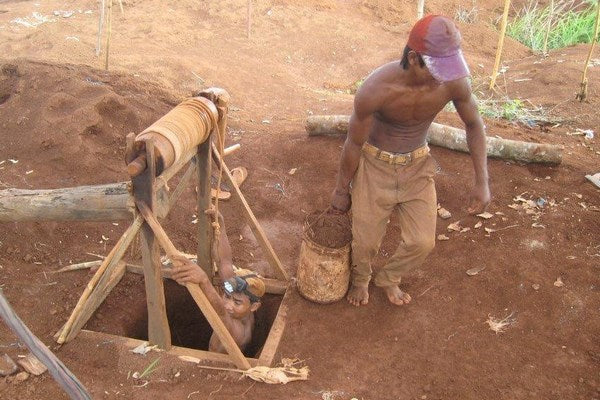
Today, however, they are found almost exclusively underground. To find them we must therefore resort to miningsometimes with still very rudimentary methods in developing countries.
There, theMiners work in open pits with makeshift tunnels dug next to the deposits they use manual tools for stone extraction. Only some of them have access to more advanced tools like compressed air drilling devices or even explosives.
Larger companies use mining industrial machines such as excavators, hydraulic drills, bulldozers, underground vehicles or even “shaker” machines that separate rocks of different sizes.

A good number of stones are also found in riverbeds where mining methods remain quite traditional (albeit on a larger scale) as is the case with gold mining.
Are they destined to run out?
The larger deposits of some stones have been worked for many years. This means, for example, that for stones such as malachite, agate or even garnet it becomes so increasingly difficult to find quality stones. Although there are still many stones, most will be of lower quality than what has been extracted so far.
Other parameters influence the volume of gemstones mined as government regulations and controlsthis is especially true in China with turquoise. The advantage of these measures, however, is to offer better working conditions to miners and to preserve the ecosystem near the mining site.

Ultimately, although some deposits may run out in the near futureothers are discovered regularly. After all, larimar and tanzanite were only discovered in the last 40 years. Furthermore, many stones around the world are waiting to be passed on to new generations through inheritance or simply to be resold.
Why are they so popular?
Depending on how much of a certain type of stone can still be mined and where it is found in the world, a gemstone may be described as rare and sought after.
In other words, the more difficult it is to find and extract it, the more precious the stone will be. This is why some display exorbitant prices. After all, it is well known that we always want what we cannot have.
However, many stones are popular simply because of their natural color, properties or history.
To go further:
latest posts published

Moonstone in jewelry

Engraving of men’s signet rings

Diamond clarity: inventory of natural inclusions

Creation of a Chrisme Medal in 18K Gold

18k gold men’s necklace (handcrafted)

Recycle 800 silver into pure silver

Large 18k solid gold bracelet

18k gold chain pendant

the history and symbols behind the Mo signet ring
