

Egypt is home to the remains of one of the oldest civilizations on the planet.
He left us pyramids, hieroglyphics and a multitude of gold jewelry and artifacts with religious symbolism.
Among these symbols, the Egyptian cross is certainly the best known.
It is also called the Ankh or cross of life and its symbol is still used to make jewelery and pendants, as demonstrated by this gold Ankh pendant from our collection.
Other Egyptian symbols influenced Greek and then Roman civilization, especially the serpent.
Egyptian cross of life pendant with the different Egyptian religious symbols
For this project, we aimed to create a cross of life pendant with several strong symbols from ancient Egyptian history:
We invite you to discover the multiple stages of creation of this jewel as well as its long, but fascinating, manufacturing process. For the more curious, discover our collection of Egyptian jewelry with a unique design.
Index
- The design of the pendant
- Production
- Making the Egyptian cross of life
- Making the silver cobra snake
- Size of the lapis lazuli beetle
- Size of the Maat feather in the venturine
- Making the Eye of Horus in gold
- Suspension assembly and finishing
The drawing of the cross and the serpent
The design of this pendant is complex.
An 80mm high wooden Egyptian cross of life on which a solid silver cobra is rolled.
The cobra must be set with two carnelian stones at the height of the collar and accommodate a feather of Maat carved into the venturine stone located between the coils of its body.
The arms of the cross of life hold the Eye of Horus in 18k yellow gold on the left and a scarab carved in lapis lazuli stone on the right.
This gives us 5 items to design before we can start production.
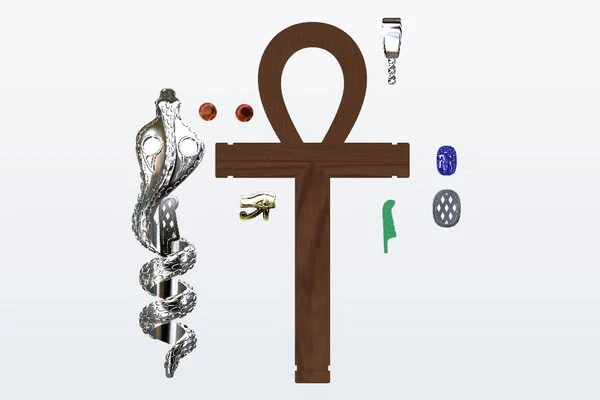
This project is complex not only due to the number of elements that make up the pendant, but above all because it will be necessary to work the wood, model in CAD, print in 3D, create the snake through the lost wax casting process, cut and sculpt the stones.
Obviously none of these stones are available on the market and we had to cut them ourselves in our laboratory to obtain stones exactly correct in shape and size.
It was a long and difficult project that we are proud to have been able to achieve 100% in our laboratory.
After studying the project, we decided that:
- The cross of life would be made of cocobolo wood in 3 assembled pieces
- The snake would be 3D modeled, 3D printed and then produced using the lost wax casting process
- The Eye of Horus is said to be crafted into an 18k gold anklet with a silver base
- The stones would all be hand cut in our workshop
The manufacturing of the different parts of the pendant
As explained, the snake had to be created through 3D modeling, having to adapt perfectly to the wooden cross and present many details (the scales, the eyes…).
To do the latter, we first had to represent the entire pendant using 3D modeling.
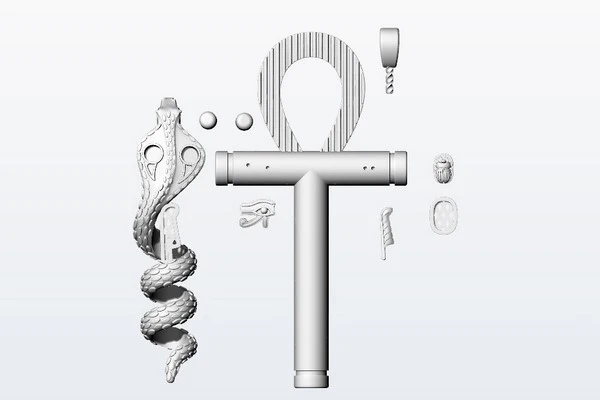
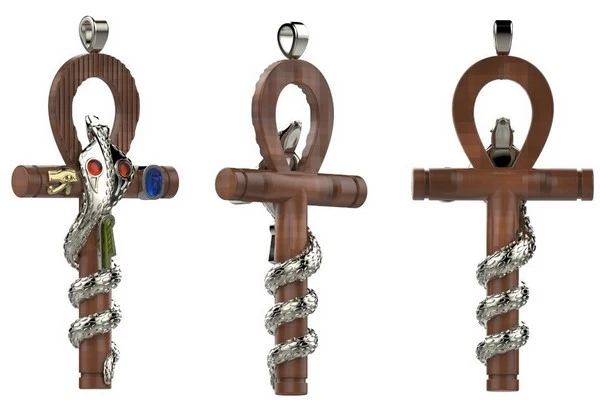
Once the digital model has been validated by the sponsor, we know all the dimensions of the different elements to be produced to ensure a perfect fit.
We can then begin the manufacture of the wooden Egyptian cross of life.
Creation of the Egyptian wooden cross of life
To make the latter we started from a piece of raw cocobolo wood that we had to cut and then shape.

The different pieces are cut from the mass to eliminate shavings and shape the pieces of the cross of life.


View of the different pieces of the cross of life before assembling them
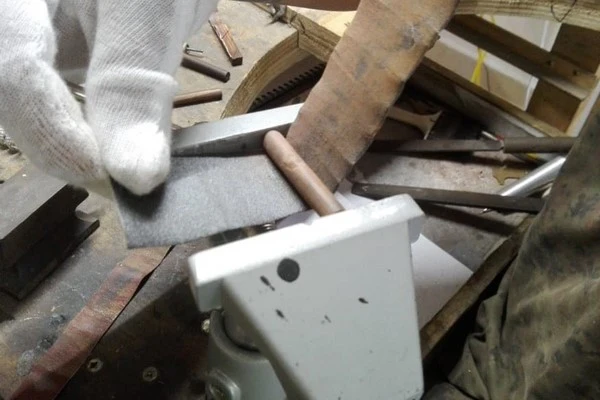
Each of the pieces is then adjusted and assembled onto a metal axis that passes through the main body of the wooden pendant.

Once the assembly is finalized, the cross of life handle is then engraved identically to the 3D modeling presented above.
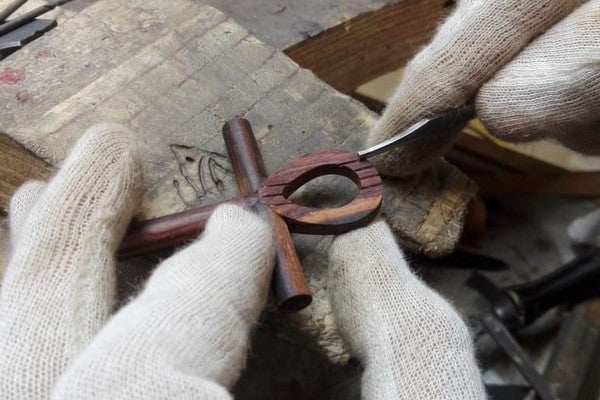
Gloves are used to avoid marking the wood, which remains a living organic material that risks becoming stained with dirt and sweat from the hands.

View of the finished work on the screw-mounted Egyptian wooden cross
Making of the silver snake
Production of the cobra began with the creation of the digital model of the complete pendant.
We then use the 3D model of the cobra for the rest of the operations.

Viewing the snake of our pendant seen alone
This is sent to a 3D printer which will allow us to obtain a resin model of our snake, identical to the one sculpted on the computer.

This wax master is used to make a refractory plaster mold and obtain the solid silver piece by the lost wax casting process.

View of cobra snake in solid silver, rough foundry
We thus obtain a faithful sterling silver reproduction of our virtual snake model seen above.
Sculpture of the scarab and the feather of Maat in stone
Stone cutting is not our main activity.
However, when it comes to making cabochons or carving stones that do not exist commercially, we carry out these operations in-house.
Creation of the lapis lazuli stone scarab
For this sculpture we started with a rough block of lapis stone.

View of the different qualities of raw lapis lazuli stone. This stone was highly prized by the Egyptians for making jewelry and amulets.
A fragment of lapis lazuli is fixed on a measuring stand with jeweler’s wax.
The pruning work will be complicated because the beetle measures only 6 millimeters in height.

The general shapes of the beetle are first drawn before starting the cutting work with a diamond cutter.
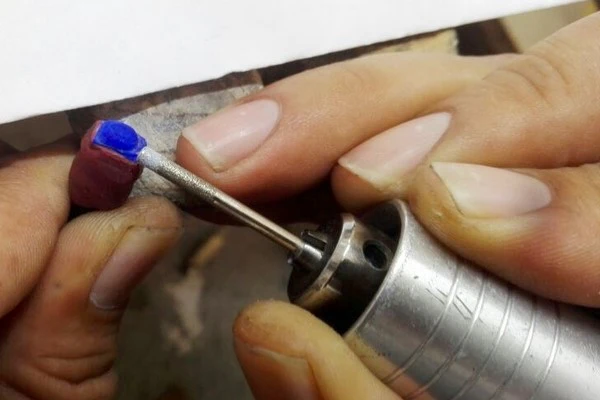
The outline of the beetle’s body is sculpted before detail work begins to represent the beetle’s head.
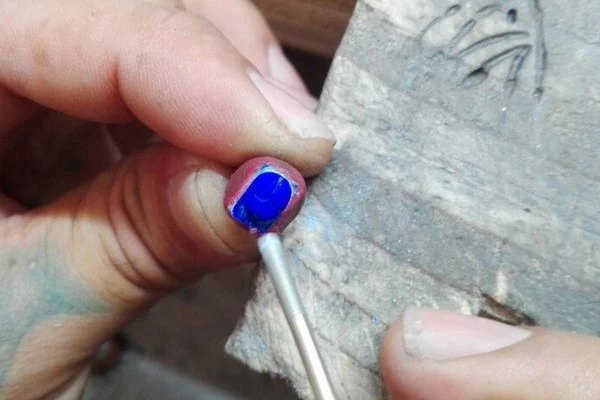
We therefore appreciate the final result.

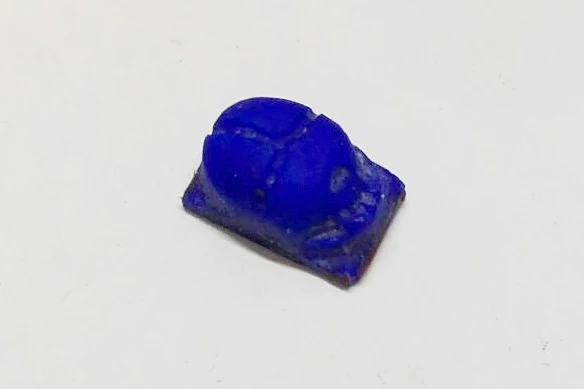
Here we can appreciate the sculpted scarab that has been removed from its dimensional stand before fixing it on its silver stand.
Sculpture of the feather of Maat in Venturine stone
The manufacture of the Maat feather is similar to that of the scarab beetle.
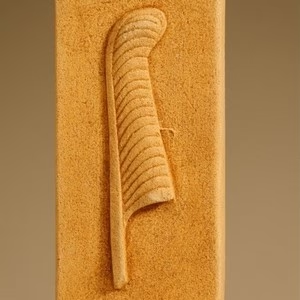
A piece of raw Venturina stone is cut and then shaped through successive cuts with a diamond saw.
Many adjustments are required for it to fit perfectly into its slot on the silver snake.
Once the external shapes and dimensions are correct, the stone is detailed at the top to give it the feather-like appearance.
This video shows the different stages of cutting the stone to obtain the feather of Maat.
Crafting the Eye of Horus
The 18k gold Eye of Horus is made of a rolled sheet of yellow gold.
The eye template is glued to serve as a cutting guide.
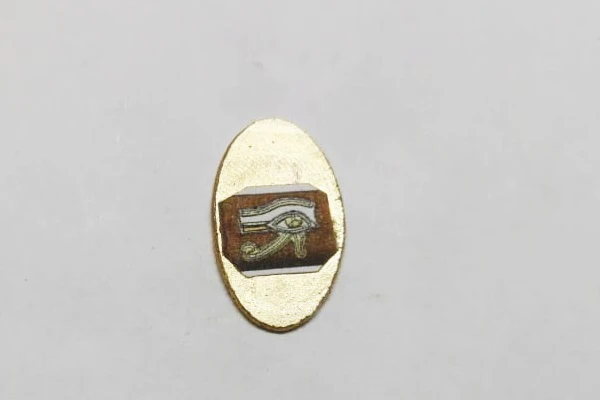

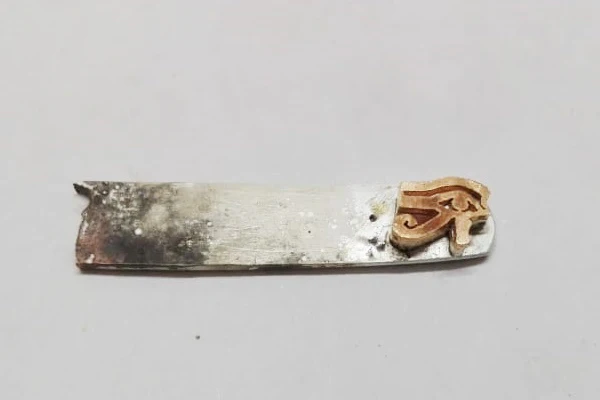
Once completed, the Eye of Horus is soldered onto a thick silver plate which will then be cut to the contours of the Eye of Horus.
This plate will serve as a support to fix this Egyptian symbol on the wood of the cross of life.
Assembly and finishing
Once ready, the different pieces of our pendant are assembled, retouched, then the pendant is carefully polished to achieve this final result.

View of the pendant on a bust showing the richness of the details and all the sculpture work carried out on the jewel.
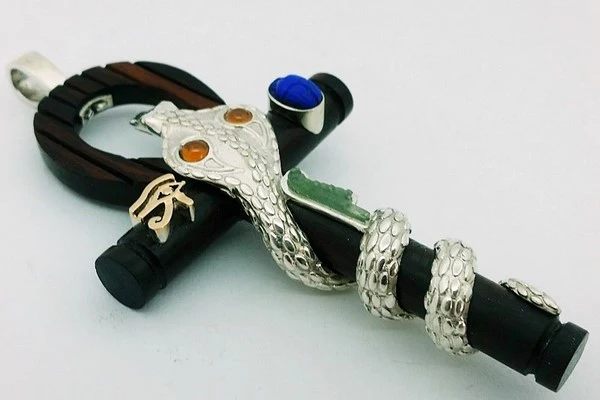

Detail view of the Egyptian symbols collected on the pendant
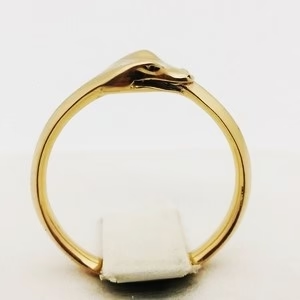
Here are other Egyptian-inspired jewelry creations made in our workshop:
 |
 |
To go further:
latest posts published

Moonstone in jewelry

Engraving of men’s signet rings
Diamond clarity: inventory of natural inclusions

Creation of a Chrisme Medal in 18K Gold

18k gold men’s necklace (handcrafted)
Recycle 800 silver into pure silver

Large 18k solid gold bracelet

18k gold chain pendant

the history and symbols behind the Mo signet ring
