
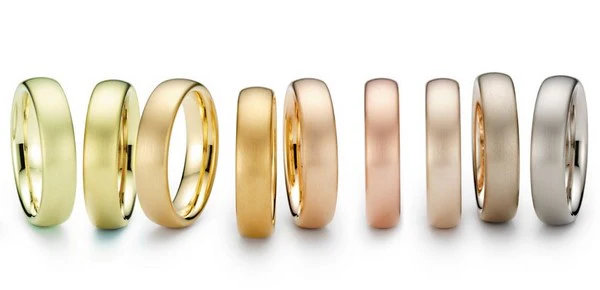
If you are looking for gold jewelry and want to learn more about this precious metal, you may feel a little lost among all the colors gold jewelry can take on.
In fact, depending on the composition of the alloy, gold can be white, pink, green or even black if we consider modern surface treatments. There are a total of 9 different shades given to gold depending on its composition or the surface treatment received.
Panel of the colors assumed by gold depending on the composition of the gold alloy.
To help you see more clearly, this article presents all the colors that gold alloys can take on depending on their composition:
Color of the gold alloys most commonly used in jewelry
As you may know, gold is a very malleable metal in its pure state, so for fine gold jewelry designs it is essential to «harden» it by alloying it with other metals. The silver and copper used for these purposes can change the color of gold depending on their proportions in the alloy, this feature has long been used in goldsmithing.
The table below shows the shades obtained by combining different proportions of copper and silver with gold.
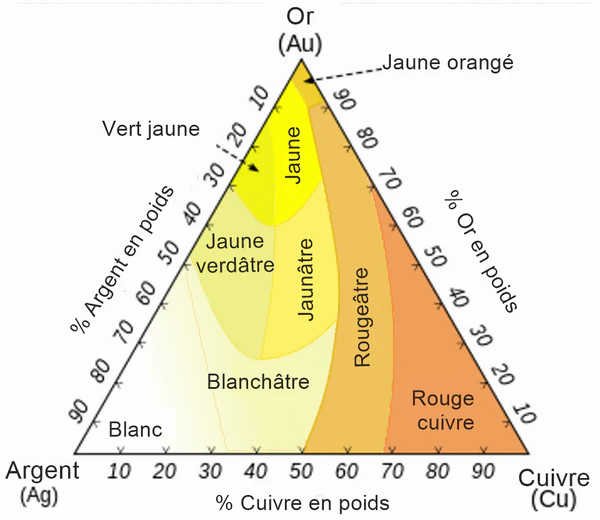
Nowadays the «recipes» for coloring gold are more elaborate and also use other metals (Palladium, Zinc, Platinum, etc.). While most jewelers use commercially prepared alloys, some jewelry stores and major brands also have their own recipes for making their own gold coloring, a hue whose composition is kept secret. The information reported here is therefore indicative.
In addition to changing the color of gold, the metal alloy also facilitates the processing of gold by rolling, casting or polishing. It can also improve frictional wear resistance. Gold alloys that are innovative in color or mechanical properties are therefore protected by patent filings.
Yellow gold: hardens without altering its color
Although gold is naturally yellow in color, to ensure that it maintains its color by adding copper and silver a good dosage of each metal is necessary, because it is also necessary to respect the legal fineness of the gold. This topic has been covered in this article on gold karats.
Composition of 22 carat yellow gold (917/1000): 91.7% Fine Gold + 5% Silver + 2% Copper + 1.3% Zinc
Composition of 18k yellow gold (750/1000): 75% fine gold + 12.5% copper + 12.5% silver
Composition of 14 carat yellow gold (583/1000): 58.3% fine gold + 11.5 to 25% silver + 11.5% to 23% copper + 2 to 7% zinc
Composition of 9 carat yellow gold (375/1000): 37.5% Fine Gold + 12.1% Silver + 44.4% Copper + 6% Zinc
View of two 14k yellow gold chains whose shade of yellow varies due to the composition of the alloy.
White gold and white gold have the same basis:
White gold used in jewelry is very often covered with a layer of rhodium to give it the final color. In fact, most white gold alloys are so called because they include metals that whiten the gold, however, the final shade in most gold tends to be light gray.
Only the use of metals such as Palladium (very expensive), Nickel (banned in France since 2000 because it is allergenic) and Cadmium allows mass-coloured white gold to be obtained.
Or White
Composition of 20 carat white gold (833/1000): 83.3% Fine Gold + 16.7%% Palladium
Composition of 18k white gold (750/1000): 75% Fine Gold + 18.5% Silver + 1% Copper + 5.5% Zinc
Composition of 14 carat white gold (583/1000): 58.3% Fine Gold + 17% Silver + 17% Copper + 7.7% Zinc
Composition of 9 carat white gold (375/1000): 37.5% Fine Gold + 62.5% Silver
Or Gris
Composition of 18k gray gold (750/1000): 75% Fine gold + 17% Iron + 8% Copper
Custom made white gold ring with rhodium plating
The shade from rose gold to red gold mainly depends on copper
It is the copper that gives rose gold its more or less red color depending on its content in the alloy. Rose gold was very popular among Russians at the beginning of the 20th century, hence its name: Russian gold.
Or 18 carats
Composition of 18k red gold (750/1000): 75% fine gold + 25% copper
Composition in 18k rose gold (750/1000): 75% Fine Gold + 22.25% Copper + 2.75% Silver
Composition of 18k rose gold (750/1000): 75% fine gold + 20% copper + 5% silver
Or 14 carats
Composition of 14 carat red gold (583/1000): 58.3% Fine Gold + 32.5% Copper + 9.2% Silver
Composition in 14k rose gold (583/1000): 58.3% Fine Gold + 24.5% Copper + 17.2% Silver
Or 9 carats
Composition of 9 carat red gold (375/1000): 37.5% Fine gold + 55% Copper + 7.5% Silver
Composition of 9 carat rose gold (375/1000): 37.5% fine gold + 42.5% copper + 20% silver
Rose gold shades depending on the copper content of the gold
Green gold also known by the ancient term electrum
Green gold is actually a natural alloy of gold and silver called Electrum. Its reflections range from yellow with light green reflections to more pronounced green.
Composition of 14 carat green gold (583/1000): 58.3% fine gold + 32.5% silver + 9% copper + 0.2% zinc
The exotic colors of gold
Black gold
Although quite rare in jewelry, black gold is still the most used of the exotic colored golds. It can be obtained by surface treatment of white gold or by alloying cobalt with gold and then by heat treatment.
To find out more, I invite you to read this article which specifically deals with black gold.
18k black gold composition: 750/1000 white gold + black rhodium surface treatment
Blue gold
Composition of 18k blue gold (750/1000): 75% fine gold + 24.4% iron + 0.6% nickel. The alloy is then heat treated to oxidize the iron and thus obtain a blue surface color.
Please note that although nickel jewelry is prohibited, there are permissible emission standards. Consult the decree of 18 July 2000 relating to the ban on nickel to find out more.
For more information on blue gold I invite you to consult the patent that concerns it directly here.
Another composition, that of 11 carat blue gold (460/1000): 46% fine gold + 54% indium
The Swiss jeweler Ludwig Muller specializes in working with blue gold.
Purple gold
Purple gold is fragile and is therefore mainly used as an inlay on more conventional gold jewelry.
Composition of 19k purple gold (800/1000): 79% fine gold + 21% aluminum
Yellow gold ring with purple gold inlay (photo source)
Sources:
Article to read to learn more about exotic gold alloys
Interesting article on natural alluvial gold alloys of surprising composition and colour.
To go further:
latest posts published

Moonstone in jewelry

Engraving of men’s signet rings
Diamond clarity: inventory of natural inclusions

Creation of a Chrisme Medal in 18K Gold

18k gold men’s necklace (handcrafted)

Large 18k solid gold bracelet

18k gold chain pendant

the history and symbols behind the Mo signet ring

Rolex: a brand that has become essential
