
Fabergé, a legendary name.
Faberge eggs: a global reference in the history of art jewellery.
Fabergé was an exceptional jeweler who worked for the greatest and most fortunate crowned heads, yet his fate brought him ruin due to the Bolshevik revolution.
No jewel in the world has been surrounded by so much pomp, bad luck, danger and then mystery following its sale, loss and rediscovery.
Fabergé eggs are certainly the most intriguing works of goldsmith’s art of all because of their fascinating history, from their creation to record-breaking auctions.
Following the Russian Revolution of 1917, the Fabergé house disappeared, after 75 years of existence.
But in 2015:
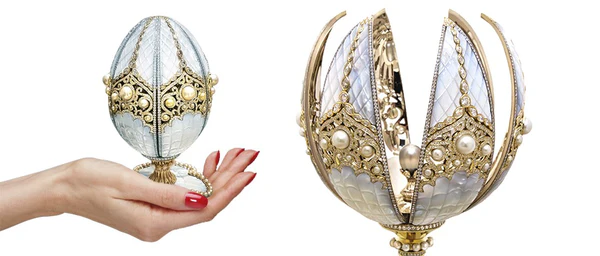
the newly reconstituted House of Fabergé (in 2007) accepts the challenge of creating a new Egg. The Birch egg and the Constellation Tsarevich Blue egg were the last creations made.
It is therefore almost a century later that the Fabergé pearl egg completes the collection of these artistic masterpieces.
This egg from the Maison Fabergé is made up of 139 fine pearls (see article Pearls) and 3,300 diamonds. 20 artisans created the egg, estimated to cost 2 million euros, in 18 months.
Historic auctions
Made more than a century ago, the selling price The Fabergé eggs were kept secret by both the jeweler and the sponsors.
To know the value of Fabergé eggs created between 1880 and 1917, we can refer to the four sales records in the history of jewelry.
- April 20, 2002: Winter egg – Fabergé – 1913.
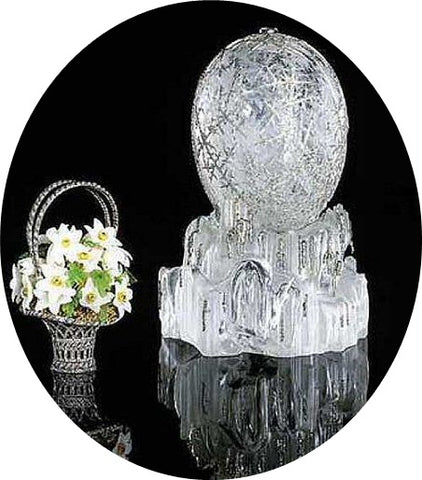
This egg was sold for 10.7 million euros during an auction held by Christie’s in New York.
- February 4, 2004: Russian billionaire Victor Vekselberg purchased the Forbes family’s collection of 180 pieces containing nine eggs. This collection was estimated at approximately 120 million euros.
Egg in the Coronation Carriage 1897: estimated by Sotheby’s at around 22 million euros.
The 9th Anniversary Egg -1911: Estimated at around 12.5 million euros by Sotheby’s.
L’oeuf à l’oranger 1911: estimated at 12.5 million euros at Sotheby’s.
- 28 November 2007: Rothschild Fabergé egg – 1902
Auctioned by Christie’s in London, the egg was purchased by collector Alexander Ivanov for the handsome sum of 12.5 million euros.
- Spring 2014: Ribbed blue enamel egg -1887
Found at a flea market in the United States, the egg contains a Vacheron-Constantin watch. It was purchased by an anonymous collector for around 24 million euros.
As we can see, historic Fabergé eggs are art and collectible pieces whose prices rival those of other world-famous classical art pieces.
Price today
If you want to buy a Fabergé or Fabergé-style egg, there are several offers on the market to suit all budgets.
Recently the Maison Fabergé designed a collection of four eggs representing the four seasons of the year. The entire collection is said to be worth €3.15 million or around €784,440 each.
From right to left, Spring Emerald, Summer Sapphire, Autumn Ruby and Winter Diamond. (Maison Fabergé)
If your budget is more conventional, you still have several options to satisfy your passion for these pieces:
Impérial Paris is a commercial site that offers copies of Fabergé eggs from 55 euros to 825 euros. The materials used are non-precious metal alloys, rhinestones and enamel
The Wonders of Russia is an online store specializing in Russian products. It sells copies of Fabergé eggs handmade by Russian producers online.
Their copy is authorized by the Fabergé family. The prices of Fabergé style eggs vary between 39 and 380 euros. The materials used are rhinestones, non-precious pearls and non-precious metal alloys.
On Ebay you regularly have the opportunity to purchase Fabergé style eggs at prices ranging from 5 to 70 euros. The eggs auctioned are supplied by the company The wonders of Russia.
If you would like a Fabergé style egg of your own imagination in gold or silver, with precious or fine stones, ask your artisan jeweler for a quote.
Where are Fabergé eggs displayed?
Fabergé Museum Baden-Baden
Fabergé Museum in St. Petersburg
Virginia Museum of Fine Arts
Walters Museum of Art
HillWood Museum
Where are the eggs hidden?
After the Russian Revolution of 1917, the Bolsheviks sold eggs to pad their coffers.
Many were sold throughout Europe at prices well below their real value. By combining different sources of information, in 2016 we developed this map to geolocate eggs.
Map showing the location of the Fabergé eggs (click to enlarge)
These unique masterpieces were commissioned by the richest families of the 19th century. Alexander III of Russia, initiator of this tradition, had 10 made and his son Nicholas II 42. As for the other eggs:
- 7 were commissioned by the Kelch family,
- 1 for the Youssoupov family,
- 1 for the Rothschild family
- 1 for the Duchess of Marlborough.
Other eggs were produced for wealthy families but their identity remains anonymous.
The artists of the House of Fabergé
Due to their mechanical complexity, high-precision manufacturing techniques and the high quality of the raw materials, Fabergé eggs are today the symbol of high jewelery excellence. Always imitated and never equaled, few houses are capable of reproducing these art objects.
The goldsmiths
To understand the enthusiasm this topic arouses we must return to the historical context of their creation.
The House of Fabergé was created in 1842 by Mr. Gustave Fabergé, a Russian jeweler of French origin. His sons Pierre-Karl Fabergé and Agathon Fabergé were noticed by Alexander III during an exhibition in Moscow in 1882. (Biography of Pierre-Karl Fabergé). They imagine and plan a collection of eggs, all competing in ingenuity and know-how. This great success can be explained in particular by Karl Fabergé’s ability to train and manage a talented team of jewelers.
In fact, while he set the standards for the house of Fabergé, he relied on his workshop leaders to perfectly execute the production of the imperial eggs. They were the best goldsmiths and jewelers in Europe.
We recommend viewing this slide share to discover these talented artists:
The Craftsmen of the House of Fabergé (source BijouterieVivalatina)
The watchmakers
The house of Fabergé also invited Swiss haute horlogerie manufacturers such as Vacheron Constantin (now part of the Richemont group) to produce eggs containing watches.
The Egg with the Serpent Clock (1887) and the Chantecler Egg (1904) are certainly the most notable works both for their mechanical and aesthetic complexity.
The egg with the snake clock spins around the egg and indicates the time.
The Chantecler egg contains as a surprise an articulated rooster that starts to crow every hour.
And today?
Following the Russian Revolution of 1917, the House of Fabergé had to cease its activity for many years. Having taken refuge in Switzerland, the company came back to life in 2010, opening its first store in Geneva.
Although the Fabergé name was reacquired in 2007, Karl Fabergé’s great-grandchildren are helping to restore the noble titles of the House of Fabergé.
New jewelery collection from the Maison Fabergé
With the help of a South African investor, the house of Fabergé has launched its first high-end jewelery collection.
Each jewel in this 100-piece collection ranges from $58,000 to $8 million.
The Frenchman Frédéric Zaavy has been the official designer of the house since 2009. His works oscillate between ancestral heritage and modernity.
The creation of Fabergé eggs
Nothing was beautiful enough to decorate a Fabergé egg: precious stones, fine stones, pearls, precious metals etc…
It is difficult to provide all the items listed both due to their diversity and their quantity, but one thing is certain: all the materials used have been carefully selected both for their rarity characteristics and for their aesthetics.
To give you an idea:
- The Standard’s Egg (1909): egg containing the miniature imperial yacht of Nicholas II:
- Tsarevich egg 1912 : It is a lapis lazuli egg containing the portrait of Alexis Romanov as a surprise.
How were Fabergé eggs made?
You work around jewelry Vivalatina Jewellery
Origin and symbol of the egg: the key to their success.
The Romanov family: Nicholas II and his wife Alexandra Fiodorovna surrounded by their 5 children.
The origin of the Easter egg tradition.
In the 19th century the commemoration of Christ’s resurrection was considered the most important event of the Christian liturgical year.
Much more important than Christmas, Easter came after 40 days of Lent (period of spiritual preparation for the Easter celebration).
In Eastern European countries, Orthodox Christians were forbidden to eat chicken eggs during Lent.
Eggs not consumed in this period were then preserved and recycled into decorative objects (hollowed and then painted) to be offered. It is therefore from this tradition that Fabergé eggs are born.
The symbolism of the egg
The artistic and financial values represented by Fabergé eggs are not the only reasons for their timeless success.
It is the life stories that these masterpieces tell that make them unique.
We know in fact the tragic extermination of the Romanov family in 1917, but also the unconditional love of Nicholas II for his wife Alexandra Fiodorovna, or the obligation for Alexander Kelch (one of the richest men in Russia) to sell matches to survive, then his extermination in a gulag in 1930.
It is because these eggs speak to everyone that they will remain living legends.
To go further:
latest posts published

Moonstone in jewelry

Engraving of men’s signet rings
Diamond clarity: inventory of natural inclusions

Creation of a Chrisme Medal in 18K Gold

18k gold men’s necklace (handcrafted)

Large 18k solid gold bracelet

18k gold chain pendant

the history and symbols behind the Mo signet ring

Rolex: a brand that has become essential
