
Pre-Columbian American Indians are known for their religious artifacts, sculptures, and turquoise jewelry.
It is believed that the Toltecs developed and controlled the turquoise stone trade in the region that would later become Mexico.
All the Amerindian civilizations flanked or succeeded each other, so that there were enormous influences from each other of these civilizations which led throughout Mesoamerica to the manufacture of jewellery, artisanal works of art using turquoise, a stone considered precious by both the Aztecs, the Maya and the Toltecs, who gave it more value than gold. Read this interesting article on cultural exchanges between Native American civilizations (in English, use Google Translate).
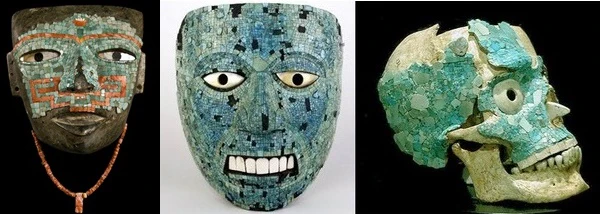
From left to right, Teotihuacan funerary mask (INAH Mexico), Aztec mask, and decorated Zapotec human skull. The three pieces are inlaid with fragments of natural turquoise.
In Nahuatl, a language common to the Toltecs and Aztecs, «chalchíhuitl” means fine turquoise and “tuxíhuitl” means common turquoise.
It seems that Native Americans as well as other civilizations (Persians, Pharaonic Egypt and Chinese dynasties) that exploited turquoise defined the quality of turquoise according to criteria comparable to ours.
That is to say, the purity of the turquoise blue of the stone (greenish stones are less valuable) and the smallest possible number of veins characterize the most sought after and therefore most expensive stones.
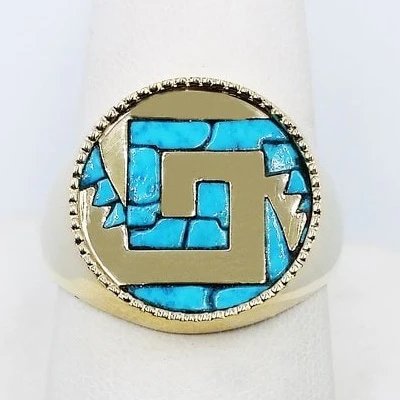 |
Mixteco ring with turquoise stone made through our online service that allows you to create a personalized ring with coat of arms or signet ring
The history of turquoise in Mesoamerica
In Mexico, turquoise sits at the crossroads of history, commerce, religion and art.
In fact, although many religious artifacts inlaid with turquoise have been found in the Aztec and Mayan regions, deposits of these stones are found in the northwest of the country.
Trade was therefore necessary to obtain turquoise stones.
The origin of the turquoise used by the Aztecs and Mayans is debated.
Early archaeological studies suggested that stones used in southern Mexico came from mines located in New Mexico, implying an extensive trade network that spanned the region via the Sierra Madre.
This theory is ambitious, but not inconsistent if we take the trouble to remember that the Silk Road (5000 kilometers) connected Asia to Turkey already 2000 years ago.
A more recent theory suggests that Native Americans directly used materials from their immediate environment.
In fact, turquoise forms naturally in copper and aluminum mineral deposits.
The Mexican states of Sonora and Baja California are currently the main producers of turquoise stones, but these fine stones are also found in the states of Jalisco, Zacatecas and Chihuahua, therefore much closer to the Aztec and Mayan regions than New Mexico.
Mexico has no turquoise mines to speak of. Mexican turquoises are secondary excavations from copper mines.
The Toltecs were the first Mesoamerican civilization to seek out turquoise for religious use.
The stone was used to inlay funerary masks, religious artifacts or make symbolic jewelry.
Because the region’s different civilizations share important cultural characteristics, many have adopted the religious use of this stone, particularly the Aztecs and Mayans.
No valid explanation has yet been given by archaeologists to explain their attraction to turquoise.
Modern use of turquoise in jewelry
If, due to its sacred and precious nature, turquoise was reserved for men in the times of ancient civilisations, currently it is women who wear the most turquoise jewellery.
Just look at the fashion magazines that present turquoise jewelry collections, aimed almost exclusively at women.
However, turquoise is also one of the rare precious stones also appreciated by men, but is then occasionally used for making personalized handcrafted jewelry.
You can see a men’s bracelet case using turquoise stones here.
Since turquoise is a fine and opaque stone, it is almost always used as a cabochon, mounted in a closed setting or inlaid in the jewel, flush with the silver or gold of the same.
Price of a jewel with turquoise
Turquoise is a precious but convenient stone, its price has nothing to do with that of precious stones.
A stone generally costs a few tens of euros and can reach a few hundred euros, in the case of a stone of exceptional size and quality.
Obviously we are talking about natural stones here, because synthetic stones or imitations are more convenient. This article on turquoise deals precisely with the topic of unnatural turquoise stones.
Unlike diamonds and sapphires whose quality and value are evaluated according to precise criteria (the famous 4Cs) of weight, purity, color and size, that of turquoise is based on the colour, the vein matrix that distinguishes the stone and its rarity.
The evaluation is much more subjective, because if the natural shade of turquoise can vary from light blue to intense green, the evaluation of its color depends on the region. Likewise, some people will tend to prefer turquoise with a strong signature while others will look for stones without veining.
The photo below shows two turquoise stones from Afghanistan.
The two stones cost the same price (around 100 euros) while the one on the right, turquoise green in color and heavily imprinted, weighs more than 36 carats, almost double that of the one on the left which is only 15.4 carats.
Turquoise processing for Vivalatina jewels
Mexican jewelry artisans inherited, among other things, Aztec and European culture, valuing and using turquoise for jewelry.
This is why this stone is used to make Mexican silver jewelry, in the form of a stone setting or fragments set into jewelry.
Logically, we ourselves have the opportunity to work with turquoise, whether natural or synthetic, to create our jewels.
Turquoise is a brittle stone that cuts well with diamond discs and is easy to polish.
He is fragile in nature and this can sometimes complicate the stoning operation.
Cut a turquoise into a cabochon to bring it to the right size to mount on a piece of jewelry.
Here are some examples of our silver jewelry with turquoise stones:
Silver ring with natural greenish turquoise, faintly impressed, accompanied by an onyx.
Articulated silver bracelet engraved with inlay of green turquoise fragments (fixed with resin).
Silver cross pendant with a turquoise cabochon in the center, the stone is natural.
Bracelet with turquoises in solid silver. These turquoises are synthetic. Note that these are neither closed nor inlaid but secured by a nail running through them and a bent end.
The different colors of natural turquoise
We are usually accustomed to a uniform turquoise color on commercial jewelry or on the pages of fashion magazines.
In fact, unmolded light blue turquoise is rare, most coming from Iran, which has been the source of the most beautiful turquoise for centuries. Today, American turquoise mines in the Southwest rival Iranian stones in quality.
You will understand that the stones featured in magazines and major jewelry chains are synthetic or imitations.
Please note that while French law is strict on the use of the adjectives «real» and «natural», it nevertheless allows a synthetic stone to be called a «fine stone». Please see this customs page to learn more about the topic.
example of the different shades that turquoise stone can take on
American turquoise stones from the Cerillos mine. Note the color variations and the different types of matrices.
The more copper the stone contains, the more it tends to blue, while iron and chromium accentuate its green color.
You can buy turquoise stones online at these addresses:
Sources:
Paquimé Amerindian archaeological zone (in Spanish)
To go further:
latest posts published

Moonstone in jewelry

Engraving of men’s signet rings
Diamond clarity: inventory of natural inclusions

Creation of a Chrisme Medal in 18K Gold

18k gold men’s necklace (handcrafted)

Large 18k solid gold bracelet

18k gold chain pendant

the history and symbols behind the Mo signet ring

Rolex: a brand that has become essential
