
The curb chain is certainly one of the oldest types of chain.
The design is simple, threaded and then woven, but fascinating for the weaves that they manage to present.
Singer C. often appears in photos with a large silver triple curb chain bracelet.
We had the opportunity to reproduce this solid silver bracelet on behalf of our client.
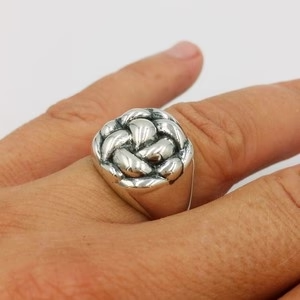 |
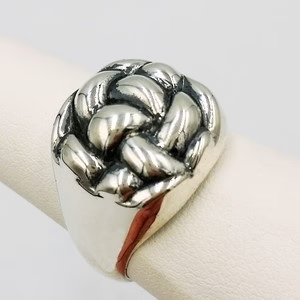
Photo of a silver knot ring that the singer also wore
This type of three-row bracelet is characterized by the fact that each row is twisted in the opposite direction to the adjacent row. This bracelet is now available in our 925 silver bracelet collection.

Production of the curb chain
We will have to make two types of chains, one of more than 40 cm twisted to the right while the other of just over 20 cm twisted to the left.
Production begins by rolling silver wire large enough for our project.

Rolled silver wire, for this result we will need more than 200 grams
Our wire is then wrapped on a metal axis to obtain a spiral of silver wire, which, cut longitudinally, will give us the links of our chain.
Assemble the round silver links that make up our chain
Once the chain has reached the right length, the sawn links are welded and then the chain is tensioned.
The links can then be twisted one by one, then the chain is struck with a mallet.

Model the curb under tension
The chain is then filed to give it the faces, characteristic of filed curb chains.
It should be noted that not all curb chains are necessarily archived.
The chain is glued to a wooden backing to keep it fixed for storage.

The black we see is the glue used to attach the chain to the wooden support. We notice the white parts, the silver exposed by the file.
Our two types of chains (twisted to the right or left) thus prepared, we can now assemble them by welding.

View of the three rows of beads before welding
Each connection is thus soldered to its lateral neighbors respecting the alignment.
The sixty centimeters of simple curb chain prepared are now assembled into a triple chain of just over twenty centimetres.
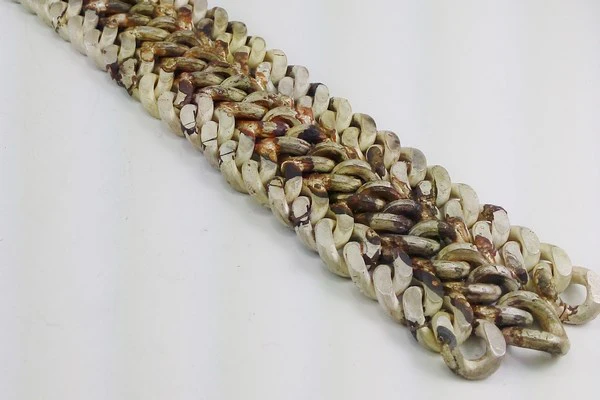
View of freshly soldered triple curb chain bracelet
Make the closure
We can then start producing the bracelet ratchet clasp. This closure integrated into the thickness of the bracelet must be as little visible as possible.
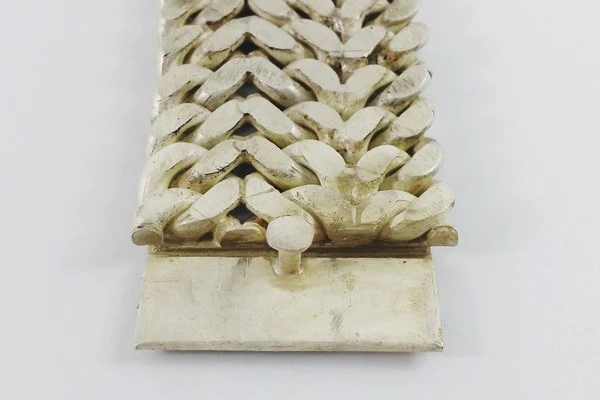
The two ends of the bracelet with the clasp blade and its pusher.


The first tests of the ratchet closure allow us to see how the pieces fit together and the discreet union of the two ends of the bracelet.
We can then start polishing the bracelet. Total polishing initially then link by link to polish the recessed surfaces.
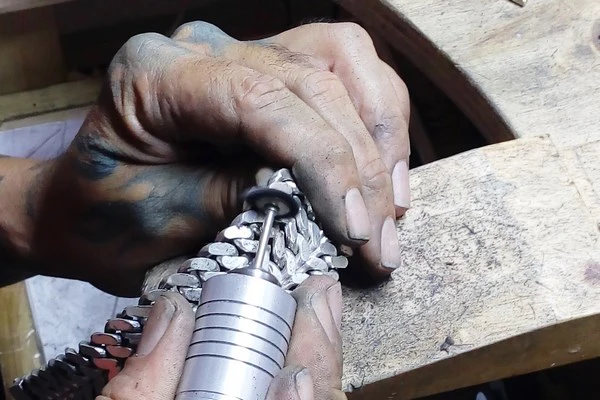
Subsequently we take care of polishing the less visible parts of the mesh.

We get our fully polished curb chain bracelet.
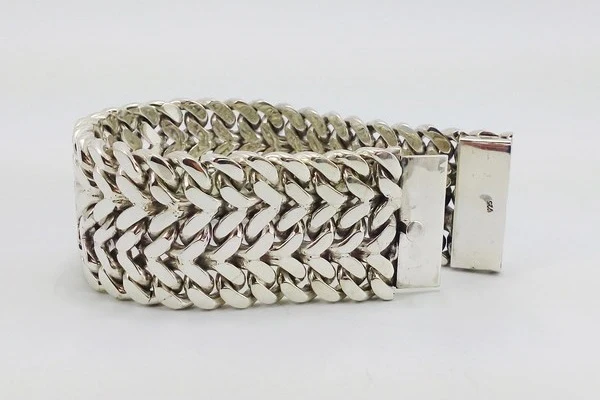


The flexibility of the bracelet is appreciated despite the links being very tight together

View of the closure, discreet after polishing
Following this publication and over time, many fans of the singer have asked us to reproduce this type of bracelet, which you can now find on our online store right here:
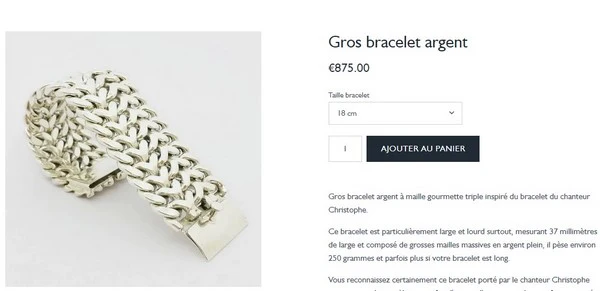
Here is another type of curb bracelet that may interest you and that we have created in our laboratory, simpler than the previous one, it is also very elegant and less heavy to wear than the other.

Details of its design can be seen here
To go further:
latest posts published

Moonstone in jewelry

Engraving of men’s signet rings

Diamond clarity: inventory of natural inclusions

Creation of a Chrisme Medal in 18K Gold

18k gold men’s necklace (handcrafted)
Recycle 800 silver into pure silver

Large 18k solid gold bracelet

18k gold chain pendant

the history and symbols behind the Mo signet ring
