
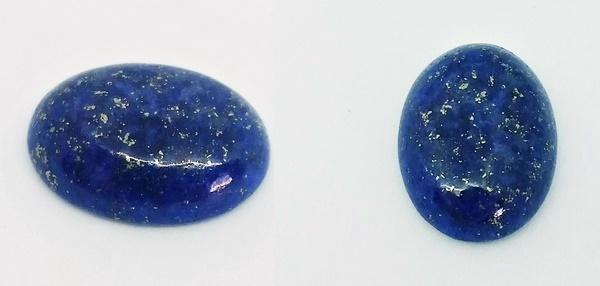
Lapis Lazuli is a rock that has been used for more than 7000 years in many artistic fields such as painting, sculpture, jewelry, etc.
Its name ultramarine has been given to it since the 5th century in Europe, when this rare and precious ultramarine blue was spoken of.
Real lapis lazuli stone cabochons used for jewelry making
Its name derives from the Latin «lapis» which means «stone» and from the Andalusian Arabic «azul» in turn deriving from the Persian «lasaward» which means «blue».
Here is a brief summary about lapis lazuli and its geographical and historical journey:
Index
Examples of custom-made jewelery made with natural lapis lazuli stones
Composition, quality and maintenance
Its main component is lazurite, which gives it its intense blue color, highly appreciated until the 19th century, especially in painting.
However, lapis lazuli contains other minerals, such as calcite, a white or even colorless mineral, also pyrite, which gives the stone this illusion of a starry sky, sometimes also sodalite or micas,…
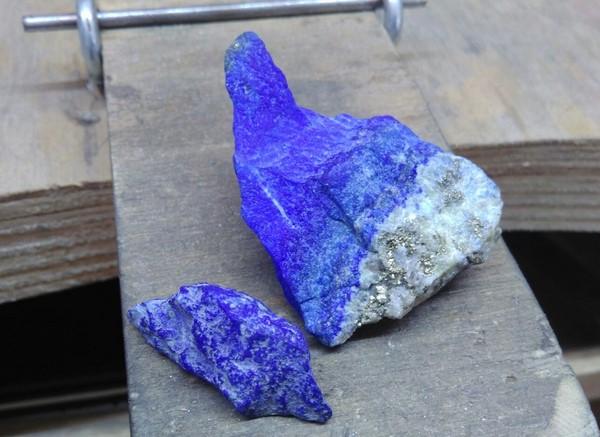
Raw Lapis Lazuli: blue lazurite, white calcite and golden pyrite
Its hardness is classified between 5 and 5.5 on the Mohs scale.
It is a very brittle stone as it is porous. It is advisable to avoid contact with chemical products or even with some slightly aggressive cosmetic products, to preserve the quality of the stone.
If you want to clean it, water and neutral soap will be fine, you can also use a cloth previously rubbed with beeswax, which will restore some shine to your stone.
The quality and price of lapis lazuli depend on its more or less intense ultramarine color and the inclusions of other minerals.
A lapis lazuli must contain at least 25% lazurite to be called such. The more calcite it contains, the lighter or even translucent it will be, and therefore it will lose its value (stone on the right, photo below).
Three grades of lapis lazuli
The most sought after color is deep ultramarine, with few or no calcite inclusions but with numerous pyrite inclusions for the glitter effect (stone on the left above).
According to Persian writings, there are three colors of lapis lazuli:
- Nili (dark blue)
- Assemani (light blue)
- Sabz (blue green)
However, it sometimes happens that this ornamental stone is found in a reconstituted form. In a case like this, the waste of this stone was usually ground into powder and then mixed with resin to give it shape.
Example of reconstituted lapis lazuli stone
Synthetic lapis lazuli is produced by the same process, except that this base powder is itself synthetic.
The stone is sometimes also simply colored, in this case contact with a little acetone partially dissolves the bluish colors
How to recognize a real lapis lazuli stone?
Please note that it is very difficult to distinguish by eye or photo a real natural lapis lazuli stone from a reconstituted lapis lazuli stone or an imitation.
Our article on turquoise and its imitations will certainly interest you for the same reason.
The testing methods I give you are destructive, unfortunately I don’t know any others, they will help you test a sample of the stones you want to buy.
Acetone test
If your stone is a common imitation colored stone, then rubbing it with a cloth soaked in acetone will cause the stone to discolor and your cloth to turn blue.
Trial by fire
If your stone is a reconstruction made from a mixture with lapis lazuli powder and resin, then it will burn in the flame and be destroyed, but you will know :).
With this blue torch flame test (indicating a temperature of nearly 1400°C), real lapis lazuli stone does not burn, disintegrate, or completely lose its color like natural turquoise does.
However, we can see that it loses its ultramarine color to take on a midnight blue color, this test is therefore destructive.
In general, to avoid buying fakes, avoid buying a stone from a Chinese or Indian supplier on eBay and whose price is ridiculous, then you can be sure that it is not a real lapis lazuli.
Lapis lazuli price
Of course, if the price offered is ridiculous, you may suspect that you are not purchasing a fine stone.
To give you a rough idea of the price of this stone, here are some examples:
- Price of low-quality lapis lazuli: less than 50 dollars per kilogram
- Price of medium quality lapis lazuli: 100 dollars per kilogram, or about 1 euro per gram
- Price of good quality lapis lazuli: 200 dollars per kilogram or 2 euros per gram
I invite you to browse this site of precious stone suppliers to give you an idea of market prices
The deposits
Lapis lazuli is found in several countries around the world: Russia (Siberia), Chile, Canada, United States, Pakistan,…
map of lapis lazuli mining countries
But the main deposit, which is also the best known for the quality of its stones, is located in Afghanistan, in the Badakhshan province, in the north of the country.
Badakhshan province and Sar-e-sang lapis lazuli mine
It is in the Sar-e-Sang mine, located about 2500 meters above sea level, that we find the most beautiful lapis lazuli rocks, intensely blue in color and containing little calcite.
However, access remains very complicated and even dangerous in these high mountain areas. Both from Kabul, its capital, and from any other point in the country.
It takes an average of 4 days to reach the entrance to the mines, by vehicle, on the back of a mule, on foot, etc. All in dangerous conditions due to the rough terrain and possible attacks.
The lapis lazuli mines are exploitable for approximately 4 months a year depending on the extreme climatic conditions of the peak.
Afghan miner from Badakhshan province
Extraction of lapis lazuli blocks from the Sar-en-Sang mine according to the article by Philip Poupin
The blocks of lapis lazuli are then shipped to the four corners of the globe to be worked there by lapidaries for figurative decorations, lithotherapy or jewelry, for example.
You can find it rough on mineral markets like here in Ste Marie aux Mines where the rock can be purchased by the kilo.
Lapis lazuli rocks for sale by the kilo at the Sainte Marie aux Mines mineral market
Lapis lazuli in the arts
Lapis Lazuli rock has been used in many artistic fields for thousands of years. But not only in its stone appearance.
In fact, lapis lazuli has long been transformed into a pigment for pictorial works, some of which are very well known.
Real ultramarine pigment from lapis lazuli rock, see full article in the Practical Guide to the Arts here
Used for example in the Middle Ages, this pigment was used for miniatures in religious manuscripts.
During the Italian Renaissance, Michelangelo requested it for his interpretation of the Last Judgment in the Sistine Chapel in the Vatican, just like Johannes Vermeer, who, in the 17th century, knew how to use this pigment for his famous paintings, The girl with the pearl earring et The milkmaid For example.
The Last Judgment by Michelangelo, Sistine Chapel, 16th century, Vatican City
The girl with the pearl earringoil on canvas by Vermeer around 1665, Mauritshuis, Netherlands
His ultramarine blue was highly regarded in the art world although very expensive. That’s why a synthetic pigment was created in the 19th century to make the price more accessible.
But only the pigment from the rock lapis lazuli is called true ultramarine.
Lapis lazuli sculptures can be seen all over the world. Some of the most impressive are found in the Hermitage Museum in St. Petersburg, Russia.
Bronze and lapis lazuli table from the Hermitage Museum
The Louvre Museum houses some magnificent sculptures coming mainly from Egypt but not only.
You can also admire the famous Marie Antoinette nave in lapis lazuli and enamelled gilded silver, approximately 40 cm high.
Marie Antoinette’s nave in vermeil and lapis lazuli preserved in the Louvre Museum
Lapis lazuli is ubiquitous in artistic circles, primarily in jewelry.
In jewelry craftsmanship, we have found this blue rock in a large number of civilizations for millennia.
Although today lapis lazuli is accessible to all, this was not the case in Mesopotamia where it was reserved for princes and deities. The stone therefore symbolized the attributes of the Gods, the strength of life.
It also accompanied the powerful to the tomb, as in this case this Sumerian ornament found in the ancient city of Ur, in present-day Iraq.
Replica of a Sumerian ornament of a queen’s attendants, British Museum
The alleged Sumerian queen, Pu-Abi, for her part, owned the famous tiara of nearly 10,130 tiny lapis lazuli beads preserved in Penn Museum.
In ancient Egypt, lapis lazuli, called «the eyes of the gods», was also reserved for the elite.
Considered sacred, it served as a talisman to ward off bad luck and was a sign of political and religious power.
Pectoral of the Egyptian princess Sit-Hathor-Yunet: gold, lapis lazuli, carnelian and turquoise preserved at the Metropolitan Museum in New York
In both Tuareg and Kabylian craftsmanship, Berber jewelry also uses lapis lazuli for ornaments, although enamel is more often used for brilliant blue
Example of Berber jewelry from Karuni, ethnic jewelry site
In North America, Navajo goldsmiths still use this stone, just as in Nepal, where many jewelry contains lapis lazuli, sometimes reconstituted.
Navajo silver and lapis lazuli craftsmanship
We will have understood, lapis lazuli is a highly appreciated stone and has been present in the artistic field for a long time. It remains timeless and for all styles of jewellery-goldsmithery.
One of Fabergé’s Easter eggs is also made of lapis lazuli and gold – the Tsarevich egg. See our article dedicated to Fabergé eggs
Tsarevich egg, lapis lazuli shell, decorated with gold and diamonds. Preserved at the Virginia Museum of Fine Arts
To go further:
latest posts published

Moonstone in jewelry

Engraving of men’s signet rings
Diamond clarity: inventory of natural inclusions

Creation of a Chrisme Medal in 18K Gold

18k gold men’s necklace (handcrafted)

Large 18k solid gold bracelet

18k gold chain pendant

the history and symbols behind the Mo signet ring

Rolex: a brand that has become essential
