
Historically, gemstones are attached to jewelry by crimping.
This technique revolutionized the goldsmith’s art, which until then had been limited to the working of precious metals to create jewels: the art of highlighting jewels on precious metal settings in gold or silver.
The jeweler therefore has two tasks, that of a goldsmith to shape the metal and that of a setter, to mechanically fix the jewel/s onto the jewel or ring.
Sometimes the jeweler is also a lapidary, but often it is his profession to cut stones.
Here are different types of tailor-made creations set with different setting techniques commonly used in jewelry and in our laboratory.
For your ring projects with precious stones you can contact us via this online form.
The history of parure jewelry
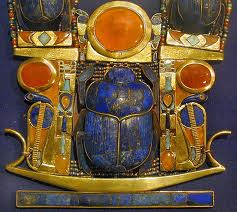
The attachment or inclusion of fine stones and enamel in jewelry dates back to antiquity, the Egyptians were the first and the pharaoh’s court, eager for fine jewelry, left us a large number of pieces that inspired 19th century jewelers.
However, we cannot speak of goldsmith’s art, because the techniques are always the same and the stones used are generally fine, but not precious, cabochon-shaped stones (the natural shape of the oval stone).
It was with the development of the European courts and the great discoveries of America and trade with Asia that precious stones arrived in the goldsmiths’ workshops.
In France, in the 17th century, the art of jewelery was born, goldsmiths were entrusted with the cut precious stones that they had to enhance the shine by attaching them to jewelry letting the light pass through.
They then developed several techniques to mechanically hang these stones without the risk of losing them.
Example of Egyptian jewelry creation that takes the shape of the carved scarab
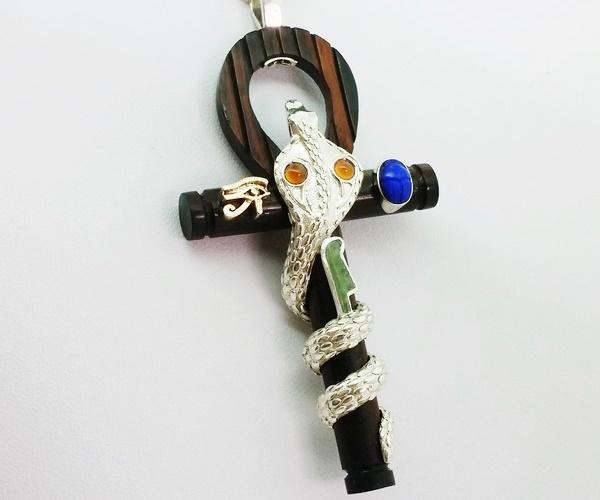
Find out more about the creation of this pendant
Jewelry setting in jewelry store
There are many setting techniques that suit the stone, jewel or style you want to give the piece.
Here the different traditional techniques are explained setting stones on jewellery.
The claw setting
The jewel setting is made up of 2 to 8 prongs which, once folded onto the stone, trap it.
This technique is generally used to fix gemstones because it allows light to pass through from all angles and enhances the shine of the stone.
The grain setting
Similar to claw setting, this technique involves setting the stone by loosening chips from the setting using a jeweler’s cutting tool and bending them over the edges of the stone.
This technique is made possible because the precious metals used in jewelry are ductile (gold, silver and platinum are not hard materials compared to others such as steel or titanium).
This is the classic jewelry setting method when paving is required.
The closed environment
A small band of precious metal surrounds the stone around its entire perimeter. This is then pushed lightly with force and then the perimeter is compressed onto the stone, allowing it to set securely in place.
This is the preferred technique for setting fine stones such as turquoise, onyx and malachite.
The rail setup
Where the stones are inserted between two tracks carved into the metal, closed at the ends. A diagram is more explicit to understand the principle.
Setting the nails
This technique is used to attach several gemstones or crystals to the setting. The image of the nail is not taken by chance. A nail of precious metal (gold, silver or platinum depending on the jewelery) is welded between the stones in order to compress the stones surrounding it, thus fixing them mechanically.
This setting technique is very similar in appearance to grain setting, but nail setting is used when you want to hold several stones in place with the same nail.
The pressure setting
This setting holds the stone in place by pressing the metal onto it. Typically used to set a single stone on a ring, the band of the ring body is opened a little too small so that by inserting the gemstone into place into the grooves in the center of the opening, the pressure of the ring body will hold the stone in place.
This type of setting does not guarantee that the ring will not move and that the stone will be lost. It is advisable to do this even with just a diamond, as fragile stones can break due to the pressure of the metal.
The invisible environment
There are other crimping techniques, often a combination of these traditional techniques. Some prestigious jewelery brands have also developed their own setting technique to eliminate the need for metal around the stone, for which we can mention the invisible wreaths by Van Cleef & Arpels or Francis Chirol’s flanged setup.
Invisible setting consists (this is very brief because I am not an expert in the technique) in creating a groove on the precious stone that will allow it to be hooked to a metal guide.
This video will show you better than words the finesse and precision of this technique:
Modern designer stone fixings
While setting is the traditional way of fixing stones, it also offers the advantage of being able to repair jewelry. In fact, if the jewel breaks following a fall or the stone breaking, it is possible to remove the stone from the setting and change it or repair the setting to re-set the stone.
However, in parallel with traditional jewelry, designers are experimenting with other fixing methods, using resin for example. This allows them to fit the stones as close to the jewelry as possible and hold them in place.
The advantage of this method is that the stone can then be finished directly on the jewel, unlike traditional setting where the stone must be finished cut before being set.
This allows the jeweler to create jewelery of different styles and with other materials such as fine wood or fossil wood as you can see in the following photos.
Setting a stone on a ring
So, in concrete terms, how do you set stones on a ring or piece of jewelry in a jewelry workshop?
On the one hand, you have to prepare the jewelry depending on whether you want to make a prong setting or a closed setting (which are the most common settings in jewelry).
To set the claws, the claws are welded in place or present on the cast iron of our ring. Then the claws are bent over the stone with a hand tool, then cut and rounded with a dome-shaped motorized tool.
In the case of a closed environment, as in the case of this suspension. The stone housing is re-drilled to the correct diameter and the walls thinned to fit the stone. The metal edges are then bent back onto the stone with a hammer.
Find out more
To learn more about the topic, we invite you to visit the following sites:
latest posts published

Moonstone in jewelry

Engraving of men’s signet rings
Diamond clarity: inventory of natural inclusions

Creation of a Chrisme Medal in 18K Gold

18k gold men’s necklace (handcrafted)

Large 18k solid gold bracelet

18k gold chain pendant

the history and symbols behind the Mo signet ring

Rolex: a brand that has become essential
