

Although little known by the general public, green gold is however the oldest colored gold used by man as it is present in nature, and is therefore called Electrum. Long before the development of the white gold and rose gold alloys widespread today, man had been using green gold since ancient times to make objects or jewellery.
Nowadays, green gold is rare in jewelry, little known and is therefore the metal of choice for making unique-looking custom jewelry. Throughout this article, we will introduce you to the natural green gold that is Electrum and explain in detail how to make a custom green gold ring with a natural emerald stone.
 |
INDEX
- What is green gold?
1. What is green gold?
Electrum is an alloy of gold and silver found in nature, the two metals can be mixed in variable proportions with a gold content that can vary from 20 to 90% depending on the natural alloys and the eras of the peoples who used this alloy.
The presence of silver in large quantities gives it a pale yellow/greenish tint characteristic of Electrum and which makes it unique compared to white gold and rose gold.
Since the green gold color is achieved by adding silver to gold, the green tint will be more pronounced as the silver content is high and therefore the gold content will be low.
The composition of 14 karat green gold (583/1000) is usually as follows:
- 58.3% fine gold
- 32.5% Silver
- 9% Copper
- 0.2% Zinc

1.1 Electrum, a thousand-year history
As surprising as it may seem, the colored golds that are the norm today did not exist until recently:
- -3000 years BC: use of electrum artifacts in ancient Egypt
- 1825: appearance of rose gold popularized by Russian goldsmiths, also called «Russian gold» at the time.
- 1912: invention of white gold by German metallurgists to replace platinum, which was much more expensive than gold at the time
The oldest electrum artefact known to archaeologists is a set of electrum jewelry and funerary objects found in Egypt, dating to the pre-dynastic period or early Old Kingdom, i.e. around -3200-2700 BC AD
In ancient times the techniques for refining natural gold into pure gold did not yet exist, natural gold combined with silver was therefore worked as for the creation of funerary jewelery in the case of the Egyptians or for minting coins in Lydia around 600 BC
 |
 |
Examples of ancient Egyptian jewelry made with electrum
1.2 Where can you find Electrum?
Natural electrum is a geologically formed alloy of gold and silver. It can be found in some gold deposits, mainly in areas where gold and silver are naturally associated.
It is found in low- or medium-temperature hydrothermal systems, where gold and silver precipitate together. The natural proportion varies from From 20% to 80% goldthe rest is silver, sometimes with copper or other trace metals.
Please note that the higher the silver content, the brighter the color of the electrum. pale to greenish.
Here are the main known places where electrum is formed or was historically mined:
- Türkiye (Ancient Lydia): The Pactolus River region, near Sardis, contains gold-bearing sands containing natural electrum, used to mint the first coins around -600 BC AD
- EGYPT: In the eastern desertparticularly around the old mines of Wadi Hammamat et Wadi Allaqi. Electrum was used as early as 3000 BC BC to make jewelry and sacred objects
- UNITED STATES (Nevada, Colorado, California): Electrum can be found in some gold-bearing quartz deposits, where the gold is partially alloyed with silver.
- SOUTH AMERICA: Pre-Columbian civilizations used electrum-like metals for their ritual jewelry (natural or wrought alloys).
- CANADA: Presence of electrum in some gold deposits of Quebec and Ontario
- AUSTRALIA: Gold deposits sometimes containing natural electrum, particularly in the Goldfields of Western Australia
- FRANCE: Electrum is present in all gold-bearing hydrothermal veins in France, particularly in well-known mineralogical sites such as La Gardette (Isère), Lopérec (Finistère), in the Morbihan, Limousin and other regions. It is also found in some alluvial deposits, where it can be collected in the form of gold flakes or grains naturally bonded with silver.
 |
 |
Electrum in its natural state (source)
2. Which civilizations worked green gold?
It is ironic that green gold is almost unknown to the general public today, even though it was used by many ancient civilizations, as detailed below:
| Civilization | Approximate period | Main uses |
|---|---|---|
| Egyptians | From -3000 to -30 | Jewellery, funerary objects, coverings of pyramids and obelisks, sacred metals linked to the divine and the sun |
| Sumerian/Akkadian | from -2500 to -2000 | Royal jewels, offers. Electrum was considered a precious metal like gold |
| Hittites | From -1600 to -1200 | Royal and religious ornaments |
| Lydians/Ancient Greeks | from -700 to -300 | Currency, jewelry, trade. The first coins minted in electro from Lydianaround -600. High value jewelry |
| Achaemenid Persians | from -550 to -330 | Imperial objects, decoration |
| Romans | from 0 to 476 | Female jewelry, decorative objects |
| Andean civilizations | from -500 to +1500 | Gold-silver-copper alloys called Tumbaga |

Frieze showing the different civilizations that used electrum
3. Properties and benefits of green gold
Since electrum is a mixture of gold and silver, it has the combined properties of these two metals.
Chemical properties:
- It is a mixture of gold (Au) and silver (Ag) that may contain traces of copper, iron and platinum.
- Its composition varies between 20% and 80% gold, it is therefore less oxidizable in air than silver but more than pure gold which is not at all.
- It is not attacked by weak acids but by aqua regia (HNO2 + HCL)
Physical Properties:
- Color variable from pale yellow to light green
- Density between 12 and 17 g/cm3 (depending on the gold content of the metal). We remind you that the density of silver is 10.5 g/cm3 and that of pure gold is 19.5 g/cm3
- Hardness variable between 2.5 and 3 on the Mohs scale, therefore harder than gold
- Melting point between that of silver (962°C) and that of pure gold (1064°C)
- Malleability between that of gold and silver
To a jeweler, electrum is processed similarly to silver and gold.
Advantages of electro:
The advantages of electro are aesthetic for the jewelry sector:
- Unique color tending towards green from which it takes its name green gold
- Originality of the alloy which differs from the white and pink gold commonly on the market
- Natural metal rich in history
Disadvantages of electrum:
- Non-standardized color that varies with gold content
- Possible surface oxidation because it contains a percentage of silver
- Little known to the public
4. Custom creation of a green gold ring
For this project, we needed to fit our client’s natural emerald stone into one of our store’s emerald ring designs.
 |
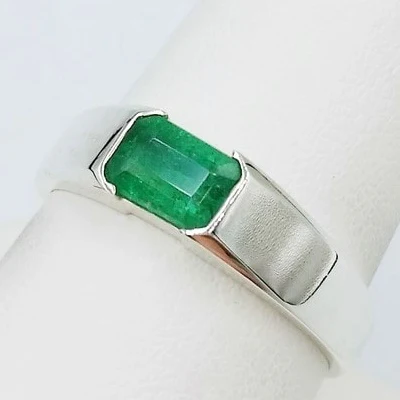 |
On the left the emerald stone to adapt to the design of the right ring
We therefore had to redo the digital model of our ring in order to adapt it to the stone, taking into account:
- change in shape from rectangular to cushion
- that this new stone is larger than the previous one
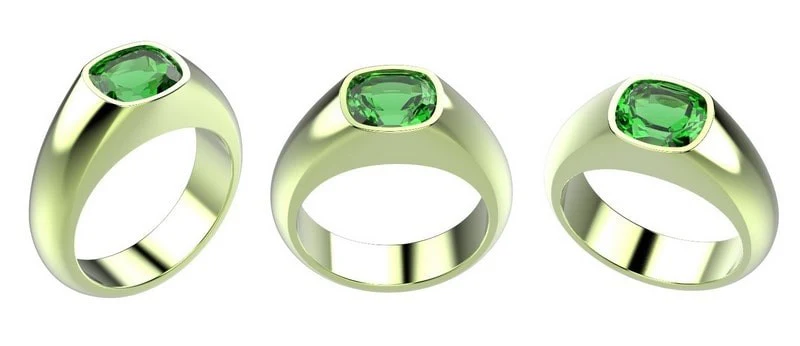
Digital rendering visualization of the ring project adapted to the stone
Once the digital model has been validated by the customer, the ring is printed in resin using the 3D printing process and then cast in electro using the lost wax casting process.
Following the filing, stone setting and polishing operations, we obtain this result for the ring.
To go further:
latest posts published

Moonstone in jewelry

Engraving of men’s signet rings
Diamond clarity: inventory of natural inclusions

Creation of a Chrisme Medal in 18K Gold

18k gold men’s necklace (handcrafted)
Recycle 800 silver into pure silver

Large 18k solid gold bracelet

18k gold chain pendant

the history and symbols behind the Mo signet ring
