

Intriguing and mysterious, the opal stone fascinates, on the one hand for the multitude of colors and sparkles it can have, but also because it remains a difficult stone to identify by scientists and gemologists.
It is certainly one of the rare fine stones still being studied and the subject of thesis to understand its chemical and granular composition, explain the play of light as well as the formation mechanism.
|
|
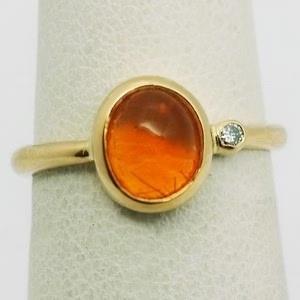
While scientific knowledge and technical means make the laboratory production of synthetic diamonds, sapphires and emeralds possible, the industrial reproduction of synthetic opals remains difficult and copies are easy to differentiate from natural opals.
Fire opal stands out among all opals for its color ranging from yellow to dark orange, almost red.
THE Mexico is the main producer of fire opalfound in volcanic regions of the country.
Opal is an emblematic stone of Mexico because it was already used by the Aztecs with jade and turquoise to create symbolic artefacts and jewels.
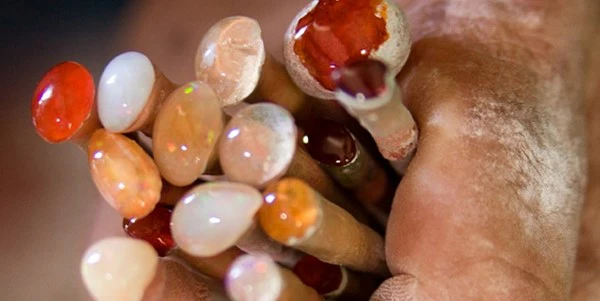
This photo shows the rich variety of colors Mexican opals can take on.
Among the opals present in this photo there are the three types of opals used in jewelry: common opals, fire opals and noble opals characterized by their play of light.
Index
Composition and formation of opals: water stones
Opal differs from other gems in two main ways: it is not a crystal and it does not have a specific color.
It is an amorphous or poorly crystallized silica that contains water.
Furthermore, the formula for its chemical composition: SiO2, nH2O clearly shows that the water content of opals is very variable, it can vary from 1 to 21% for extreme values and remains between 4 and 10% in general.
The water content of an opal can be an important factor in its appearance.
Therefore, an opal exposed to heat can dry out and lose its appearance (phenomenon called «bleaching» or «destabilization», there is no known rule, it varies depending on the stones and extraction sites).
Similarly, Wello opals (Ethiopian origin) once wet become transparent and lose their appearance which they recover when they find the optimal level of hydration for the play of light.

Welo opals, noble opals from Ethiopia
Additionally, hydrophane opals are known to be opaque opals with no iridescence when dehydrated, but exhibit color play after rehydration in a freshwater bath.
However, they are not considered noble opals.

Mexican fire opal characterized by its color and transparency. This, rough fire opal, is 22 carats and was mined from a mine in the Magdalena region.
Unlike crystalline gems that form in clusters, opals form in cracks in the rock, thus following the cavity of the rock.
This explains the complex shapes taken on by opals released from their rocky matrix.
Composition
The chemical composition of the opal, as well as its mineralogical structure, influence the behavior of light passing through the stone.
There are infinite chemical and structural combinations, which explain the great diversity in the appearance of opals.
If fire opal stands out among all common opals for its transparency and color, it is the noble opal that is the most prized in the world of jewelry.
Its luminous effects we call «color games«or»iridescence» are sought after to create unparalleled jewels.
However, a fire opal can be noble if, in addition to its fiery color, iridescence can be observed.
Let’s talk about it thennoble fire opalhighly sought after as you can imagine, which is the finest opal stone Mexico can produce.
This is possible because the color of the stone and the iridescence each have their own origin.
The color in the mass of an opal comes from colored mineral inclusions while the play of light is due to the diffraction of light caused by an ordered lattice of silica spheres that make up the stone.
The creation of this ordered network depends entirely on the opal’s formation mechanism.

Raw fire opal stone
The previous photo allows you to clearly see the play of colors of this opal which varies from yellow to orange to green.
Result of the diffraction of light incident on the ordered network of silica spheres, these plays of colors vary in position and hue depending on the orientation of the light.
This stone also offers plays of blue and red lights which do not appear in this photo.
Training
In general (because there are exceptions: Austrian and French opals) opals are formed either in sedimentary environments or in volcanic environments, the most typical of which are Australia and Mexico respectively.
Opal is a secondary atmospheric element, meaning that it forms from the dissolution of other phases and then from the reprecipitation of mobilized chemical elements.
When translated, this means that an opal results from a dried soup, a soup into which chemical elements from the surrounding environment have been mixed.

Silver brooch with fire opal made in our laboratory
The mechanism of opal formation meets these criteria:
- Presence of very siliceous rock with very small quantities of other elements
- The presence of holes or porosity
- Alteration of rock by water
- The presence of a waterproof layer, keeping water in the presence of the rock
- The gradual drying of the water+silica mixture
It should be added that a heat source is also involved in this formation process.
Two mechanisms are known to gemologists: the first is a cooling starting from 170°C, a volcanic or hydrothermal hot spring as in the case of Mexico.
Or a cooling starting from 45°C, a hot source due to tectonic movements, as happened in Australia during the formation of Australian opals.
Opal mining in Mexico
The extraction of fire or noble opals it does not differ from that of common opals.
In fact, it is when we free the opal from its rocky matrix that we discover the type of opal we are dealing with.
Its extraction is manual, rarely using machine tools (which could damage the opals) and consists (at least in Mexico) of fragmenting the rock by sandblasting and then manually crushing the pieces to look for the bright flashes that will betray the presence of opals in the rock.
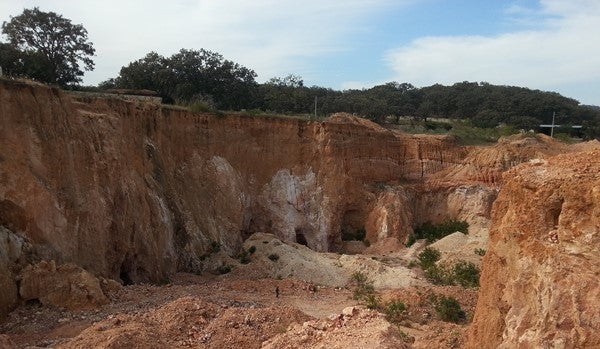
View of a Mexican opal mine near the town of Magdalena, in the state of Jalisco
If the exploitation of opal in Mexico dates back to the Aztecs, the extraction sites fell into oblivion during the Spanish conquest.
It was only in the 19th century that the fortuitous discovery of opals revived their exploitation.
Currently, opals are found in the Mexican states of Quererato, Guanajuato, Chihuahua, San Luis Potosi, Hidalgo, Jalisco, Nayarit, Guerrero, Michoacán, Oaxaca, Durango, México, Tlaxcala, Coahuila, Puebla, Zacatecas, or in 16 of the 32 federal entities of the country.
This explains why Mexico is the second largest producer of opal in the world after Australia.
The following map shows the distribution of Mexican opal producing states. Not all of them produce fire opals or noble opals. The states of Querétaro and Jalisco appear in orange.
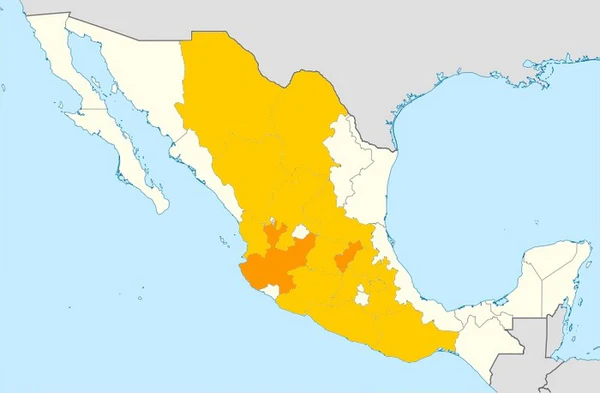
Not all of these states produce the same quantities and qualities of opals.
The state of Querétaro remains the cradle of Mexican opal where it was exploited starting in 1840, producing the majority fire opals of the country, while the state of Jalisco produces most of it noble opals from Mexico.

Noble opal in its matrix on the counter of a lapidary laboratory in Magdalena. The angle of the photo and the flash allow us to see only part of the reflections of the stone, mainly blue, while the stone gives off green and red reflections.

The same cut stone
We can see plays of green light on the top of the stone.
The cutting phase affects the play of color of the stone, this is due to the use of water for polishing so as not to heat the stone which, being fragile, could crack.
Subsequently the opal regains its color and its play of light.
The color of the rock containing the Mexican volcanic opals is characteristic of the rock veins containing the opals in the Magdalena region.
Opals in Mexican history
Archaeological studies have shown that the Aztecs knew about opals and used them to make jewelry and ceremonial tools.
The opals used came from mines located in the state of Querétaro and they called the opal Vitzitziltecpal, which means «hummingbird stone» in reference to the numerous colors that the hummingbird’s plumage can take on.
The most famous and certainly the most beautiful Mexican opal is the one exhibited at the Gainer Field Museum in Chicago.
This 35-carat fire opal adorns a brooch representing the Aztec sun god.
This is an exceptional piece in more ways than one, on the one hand it is an exceptional jewel and above all an Aztec archaeological vestige dating back 500 years.

Fire Opal Prices
Fire opals are fine stones, but their price can approach that of some gemstones.
We can find them cut into cabochons or faceted. Their price will therefore depend on their size and the intensity of their color.
Prices vary from 80 euros per carat for the cheapest to 500 euros per carat for the most beautiful.
Where to buy fire opals?
Here are some addresses where you can shop online:
Find out more about opals
France has a team of experts on the subject of opal stone, a team working at the Faculty of Nantes and coordinated by Dr. Emmanuel Fritsch.
Although his studies are not available online, you can obtain them by contacting the university.
To go further:
latest posts published

Moonstone in jewelry

Engraving of men’s signet rings
Diamond clarity: inventory of natural inclusions

Creation of a Chrisme Medal in 18K Gold

18k gold men’s necklace (handcrafted)
Recycle 800 silver into pure silver

Large 18k solid gold bracelet

18k gold chain pendant

the history and symbols behind the Mo signet ring
