
Japan shares a continuous thousand-year history with France, rich in history and stories as well as centuries-old symbols. Thus, with its samurai caste and its traditions, Japan has a medieval heraldic art very similar to that of European noble families.
This rich history is a topic of choice for making jewelry with various designs, taking as a basis both verified historical elements and the myths of the country.
This article invites you to discover the stages of making two Japanese rings by illustrating this point. One is a silver and ruby Kitsune ring and the other is a Japanese heraldic signet ring.
 |
Examples of Japanese rings made by our custom creation service
Kitsune Ring: the Japanese fox
In Japan, the term Kitsune refers to a supernatural being that takes the form of a nine-tailed fox. This term from Japanese folklore dates back more than 1500 years. Not being an expert on the subject, I invite you to consult the Wikipedia page which will tell you about it better than me.
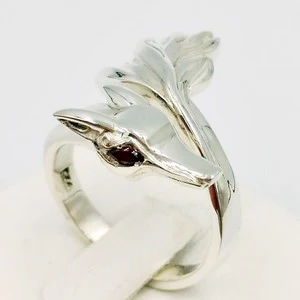
For this project, our client wanted a large ring in size 65, quite bulky, featuring a fox wrapped around his finger with the head resting on the finger and the tail sticking out at the other end on the little finger.
The fox’s eyes were to be reproduced from small shuttle-cut rubies.
After providing visual files that allowed us to fully understand the need for the shape of the fox’s head and the symbolic representation of the nine tails, we were able to begin the work of 3D modeling the ring design.
After some trial and error, we were able to arrive at the ring design desired by our client and visible below.
Subsequently, with the visualization of the realistic rendering, we have a good vision of the final result that the ring will have, the project can then be validated by the customer.
Through the 3D printing process, we can then use our digital file to 3D print the resin master of our ring design.
This is what the resulting resin master looks like.
Two angle views of the resin master used to make the silver ring
Production then continues with the casting of the sterling silver ring. We prepare a refractory plaster mold using our wax master. Once dry, this mold is fired in a kiln to incinerate the mother resin which frees up space for pouring the molten silver.
We then obtain our silver ring, which once retouched and polished, receives 3 millimeter ruby stones at eye level.
Seen from the front, the ring highlights the particular shape of the fox’s head as well as the movement of the tail that comes out of the finger
Samurai heraldic signet ring
Having had the opportunity to make numerous heraldic signet rings for men, this ring project was the first involving a heraldic signet ring with a Japanese coat of arms and was an opportunity for us to discover more about this culture.
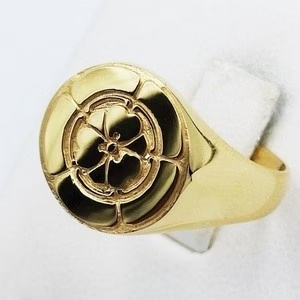
Our project was to create a signet ring decorated with the Akimoto clan crest, seen below.
The instructions for this project were simple, create a heraldic engraving of this Japanese clan’s crest on a round 18k yellow gold ring tray.
Furthermore, I am talking about heraldic art when I should use the term MON or KAMON when talking about Japanese family arms. Since I am not even an expert in this topic, this article will tell you more.
I found little information online about this coat of arms which seems to represent a cherry blossom with these 5 petals. You should know that the cherry blossom is a centuries-old symbol that today takes on a philosophical symbolism and is the emblem of the entire Japanese nation.
Exactly like the Japanese ring project presented previously, this project also begins with the digital modeling of the ring, a phase that allows us to confirm the design with our client, thus avoiding any possible source of error between his expressed desire and the interpretation we could make of it.
Realistic 3D model visualization of this ring design, giving a good idea of the final rendering of the ring that has not yet been made
The actual creation begins with the 3D printing of the resin master of this signet ring, created starting from the digital file previously obtained.
These two views show the balloon reproduced in relief on the ring plate
This is followed by the lost wax casting operation which leads us to pour the molten gold into the mold made from the resin of our ring master.
We therefore obtain our 18k yellow gold ring, which once retouched, detailed and then polished gives us this final result:
You’ll notice the polished gold finish of the crest while the background of the engraving is brushed gold to provide this nice contrast that highlights the weapons of the Akimoto clan.
To go further:
latest posts published

Moonstone in jewelry

Engraving of men’s signet rings
Diamond clarity: inventory of natural inclusions

Creation of a Chrisme Medal in 18K Gold

18k gold men’s necklace (handcrafted)

Large 18k solid gold bracelet

18k gold chain pendant

the history and symbols behind the Mo signet ring

Rolex: a brand that has become essential
