
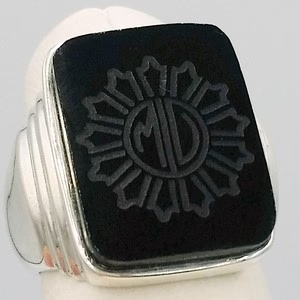
Intaglio rings are not at all fashionable, they are not even known to the general public at all.
Yet, everything is fascinating about these rings, both their manufacturing method, which has not changed much over the centuries, and their thousand-year history, which carries within it the traces of the numerous civilizations that preceded ours and left their mark on the creation of modern intaglio rings.
Opening the chapter of this type of rings means immersing yourself in the history of the world and antiquity, in myths and legends, in a fascinating world full of adventures, fantastic animals, deities, but also everyday objects and scenes of life from antiquity in Egypt, Mesopotamia or the Roman Empire.
These rings only attract scholars, history enthusiasts who marvel at a stone modeled by hand centuries ago and which has gone through the ugliness of the world to reach us and leave its testimony of a bygone era.
Because ancient carvings are often displayed in museums or are extremely expensive, copies or reproductions are made so that they can be worn.
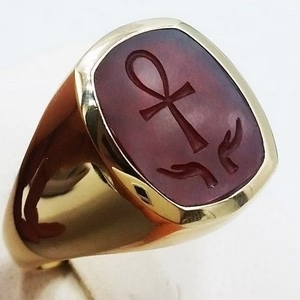 |
Two examples of intaglio signet rings made in our workshop. Find out the price of a signet ring with heraldic engraving here. You can discover other more conventional designs of men’s rings and signet rings in 18k gold here.
INDEX
- What’s special about the carvings?
- Intagles, a thousand-year history
- Stone engraving
- Engraving techniques
- Creation of a Cornaline intaglio ring in gold
- Creation of Onyx carving ring in silver
What makes cutwork rings special?
Intaglio rings are rings with a fine stone engraved in the cavity that can act as a seal. These stones can be opaque or translucent, as we will see later.
The cameo, on the other hand, is a stone engraving in relief, generally performed on an opaque stone, to better appreciate the reliefs.
We would like to point out that there are engraved stones that cannot be used as a seal, these stones are precious translucent stones engraved on the back of the stone and whose engraving is appreciated for the transparency of the latter. They therefore have a cabochon-shaped or classic cut face which is not used to seal documents.
On the left, a Roman amphora carved into a dark blue agate stone. On the right, the portrait of Demosthenes, a famous ancient Greek orator, engraved on a cabochon-cut amethyst stone
Beyond their physical particularity, the carvings very often refer to illustrious figures of antiquity, represent divinities or scenes from mythology, or even reproduce objects of daily life in antiquity.
The history of rings with engraved precious stones
The history of these rings begins thousands of years ago in Mesopotamia with the development of Glyptics, or the art of engraving precious stones, in particular to create cylindrical seals.
About 5,000 years BC the first developed (known) civilization appeared in Mesopotamia and with it the first laws, property titles and official documents signed by the populations involved appeared.
At the time, the signature was made using a roll of precious stone engraved by hand (and therefore unique) rolled and pressed onto fresh clay tablets, thus leaving its imprint and certifying the participation of the signatory.
Cylinder seal with clay mark from the Uruk period
With the development of this know-how it becomes possible to cut smaller stones more finely, which when set on the rings, allow the wearer of the carving ring to easily dispose of their seal without the risk of losing it.
The intaglio ring is the ancestor of heraldic engraved signet rings and signet rings, as stone engraving (glyptic) techniques developed well before man was able to use metals, the Bronze Age began only 3000 years before our era.
Here is an example of intaglio signet rings from Mesopotamia.
The Mesopotamian civilization greatly influenced the Egyptian civilization, also known for its stone-engraved artifacts, especially the scarab-shaped amulets found in countless tombs.
The latter subsequently influenced both Greece and ancient Rome, which produced their share of carved rings bearing the effigies of, among other things, their gods.
Example of an Egyptian scarab cut from a piece of lapis lazuli stone and then mounted on an Egyptian cross of life pendant, made in our jewelry workshop
The different stones that can be engraved
All stones can, in theory, be engraved. It all depends on the talent of the engraver and the risks he is able to take when engraving fragile stones or those with internal tensions that could lead to breakage.
This is especially true in the case of emerald stones which are naturally highly set and fragile. Gemstone cutting requires great control and significant costs, simply due to the price of the stone alone and the risk of some stones breaking.
The precious stones that we will most often find for carvings, whether modern stones or ancient stones, are:
- Carnelian: color ranging from dark yellow to orange almost red, gives a very beautiful visual rendering and allows you to clearly distinguish the reliefs
- the agate
- The lapis lazuli stone
- Black or green onyx
- The blood stone
- Amethyst stone
- Jasper
Precious stone engraving techniques
In principle, the carving of carvings has not changed since the appearance of this technique 7000 years ago.
The principle remains that of removing the material in stages, following the contours of the design to create the cavity that will create the desired design.
The tools have completely changed and engravers use magnifying glasses with lighting, motorized tools and cutters as well as polishing pastes with diamond dust which allow them to work much more efficiently than their ancient predecessors.
However, the technique and tricks of the craftsmen allow them to create real works of art, as shown in this video detailing the different stages of carving a scarab and carving in a carnelian stone.
Modern tools now allow stones to be automatically engraved using numerically controlled machines to reproduce texts, drawings or images faithfully and economically.
If the result is not strictly identical to manual intaglio engraving, the fact remains that these techniques make it possible to democratize this type of engraving and obtain more than satisfactory quality results.
The jeweler craftsman can engrave soft stones with the diamond tip.
Large producers, for their part, use dedicated machines for the mass production of stones with identical engravings allowing the simultaneous engraving of multiple stones.
One of the best known and recognized European companies for the quality of the engraving of these natural stones in series is the German company Lorenz-Gravuren.
Even if modern techniques compete today with the know-how of the artisan engraver, the latter remains the only one able to offer tailor-made antique works, his know-how has a deserved price.
Creation of an intaglio ring with carnelian in 18k gold
This 18k gold intaglio ring design features a classic design with a barrel-shaped top topped with a carnelian stone engraved with Egyptian motifs.
The peculiarity of the ring is the height of the plate which is full, the ring therefore weighs 22 grams in 18k yellow gold. Below you can see the draft of the project before its implementation.
The engraving of the carnelian stone is done in a traditional way, it is done by hand carving and the quality of the engraving is checked using modeling paste to clearly see the quality of the background of the engraving and the yield that the wax seals made with this carving stone will have.
Finally the stone is mounted and we can see the final rendering of the ring worn on the finger.
Creation of an intaglio ring with Onyx in solid silver
This intaglio ring design is crafted from solid sterling silver on an onyx stone engraved by a modern CNC engraver. This design is very different from the men’s signet rings in our collection.
Why this choice?
The goal is to engrave a logo that is visible on the onyx stone and not to make seals. this did not justify the financial investment of a modern traditional engraving. Additionally, CNC engraving allows multiple engravings to be made side by side in a symmetrical manner, which is not the classic style of hand intaglio engraving.
The design of the project can be seen in these visual renderings of the digital model of the ring project.
As you can see in these images, the onyx stone protrudes well beyond the ring plate, giving it an antiqued style that is part of its charm.
Above, these examples of intaglio rings in onyx on the left and lapis lazuli on the right show what can be achieved, through our custom ring creation service.
This type of understated cutwork ring was often worn on the little finger
To go further:
latest posts published

Moonstone in jewelry

Engraving of men’s signet rings
Diamond clarity: inventory of natural inclusions

Creation of a Chrisme Medal in 18K Gold

18k gold men’s necklace (handcrafted)

Large 18k solid gold bracelet

18k gold chain pendant

the history and symbols behind the Mo signet ring

Rolex: a brand that has become essential
