
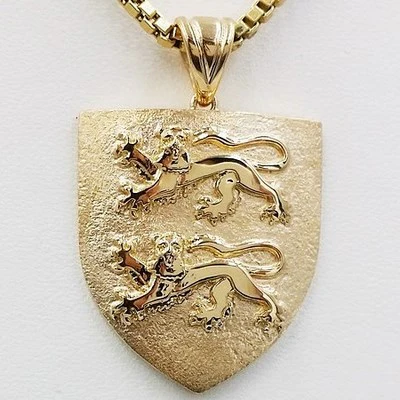
If the memory of noble families is often a source of inspiration for the creation of rings and signet rings through heraldic art, as we have had the opportunity to represent several times on our blog with the creation of custom-made signet rings, it is much rarer to have the opportunity to represent these same coats of arms as a pendant or in the form of 18 carat gold medals as happens here.
However, it is a project of this kind that we had the opportunity to carry out and which we present to you here.
This family crest pendant design is all the more interesting as it uses the Norman coat of arms, which in turn is the coat of arms of the Plantagenet family of England.
This pendant is an opportunity to remember, if necessary, the extent to which the histories of France and England are intertwined.
 |
Historic pendant depicting the coat of arms of the Plantagenêt family of England which is still that of Normandy today, this project was created through our personalized pendant creation service. This pendant hangs on a gold Venetian link chain seen in our chain collection.
Here are other examples of coats of arms reproduced in pendants
History of the Norman coat of arms and its leopards
To understand the history of the Norman coat of arms, the presence of the two leopards and its influence on the coat of arms of England, we must go back to the history of 12th century France.

Summarizing the history of Anjou, Maine and Touraine, George V known as Plantagenêt is the father of the English Plantagenêt dynasty. He inherited Normandy from his wife, and his son Henry II was the founder of the English dynasty.
I recommend reading the Wikipedia page on the Plantagenêt family armory which is simply fascinating.
You should know that the Norman coat of arms represents two leopards and not two lions. Heraldic art is sometimes misleading since the difference between the two beasts lies in the position of the head which is seen in profile for lions and from the front for leopards.
For more information on the variations of the Norman coat of arms in ancient history, this complete article on the subject is very interesting.
Design and creation of the pendant
The design of this project was simple, but original in concept. They represent the Norman coat of arms in the form of a pendant which would take the shape of a shield (the shield of the knights) maintaining the curvatures in thickness of a real shield.
The two leopards should be represented in relief with a shiny gold finish while the rest of the pendant would be in brushed gold in the background, thus highlighting the two wild animals.
The project begins by creating digital modeling of the suspension design.
Using CAD software we create the 3D model of the project which our customer can then validate or suggest changes.
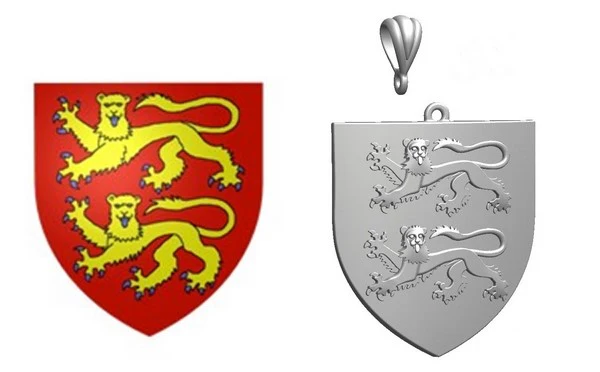
View of the 3D model compared with the reference coat of arms that served as the model

OpenCu of the visual rendering of the suspension obtained through virtual rendering
Once this design phase has been validated by our client, we can produce the resin master of the pendant using the 3D printing process.
This step consists of cutting the 3D file of our design into thin two-dimensional strips which will then be projected (via an overhead projector) onto the surface of our liquid resin. This then polymerizes, becoming solid to a very thin thickness.
The repetition of these impressions allows us to obtain a three-dimensional physical object, following the printing of approximately 600 layers of resin, each 25 microns thick.

Detail view showing the coat of arms of the Plantagenet family of Normandy with the details of the two heraldic leopards which allow us to distinguish the orientation of the mouth and the protruding tongue.
You can also notice in this image the curvature of the pendant.
The creation of the solid gold jewel follows, which takes place through the lost wax casting process. We use the master to make a casting pit, which is then immersed in refractory plaster.
Once dry, the plaster mold is placed in the oven for several hours to destroy the master, which then leaves the space free to receive the molten gold.
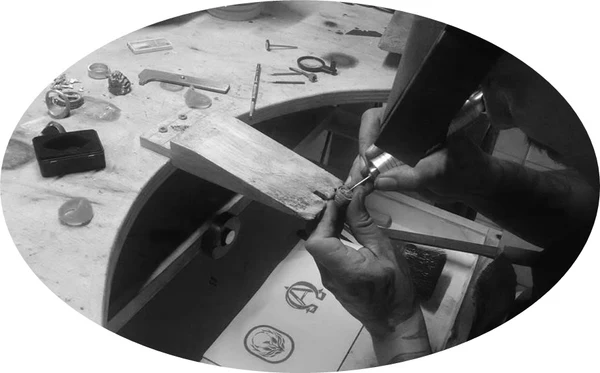
Once the 18k gold pendant leaves the temperature foundry, we can retouch it, polish it and give it the final details, such as the brushed engraving background, to give it the final look.
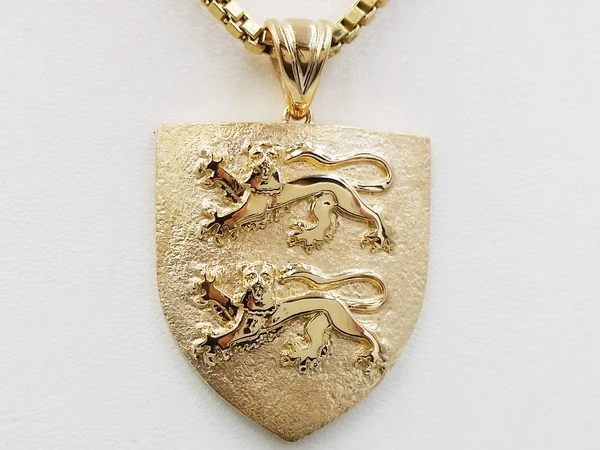

View of 18k gold pendant hanging from a gold Venetian link necklace
Here are other examples of pendants made in a similar spirit of reproducing centuries-old symbols:
|
|
 |

To go further:
latest posts published

Moonstone in jewelry

Engraving of men’s signet rings
Diamond clarity: inventory of natural inclusions

Creation of a Chrisme Medal in 18K Gold

18k gold men’s necklace (handcrafted)
Recycle 800 silver into pure silver

Large 18k solid gold bracelet

18k gold chain pendant

the history and symbols behind the Mo signet ring
