
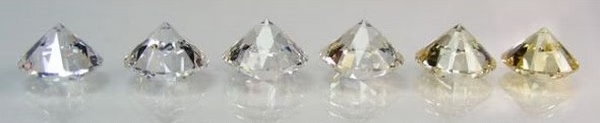
Anyone wishing to purchase a beautiful diamond or diamond jewelry of a respectable size (0.2 carats) must understand the quality scale applied to diamonds to grade them and estimate their value.
The 4Cs of diamonds for Carat (weight), Color (color), Clarity (purity) and Cut (size) is an international grading rule valid for all white diamonds.
All jewelers, diamond dealers and gemologists refer to it for understanding when comparing the quality and price of diamonds.
And so, it’s your turn understand the 4cs of the diamond to best choose your diamonds.
INDEX
Engagement ringCwings with diamond from the vivalatina collection
1. The carat measures the weight of the diamond
The carat is the unit of measurement of the weight of a diamond, one carat is equivalent to 0.2 grams.
This diamond classification criterion is the simplest to understand since it depends on the size of the stone. So the greater the weight of the diamond, the larger (and more expensive) the diamond will be for the same quality.
I recommend this article which presents in tabular form the relationship between the size of a diamond and its weight for round brilliant and princess cut diamonds.

This table gives an order of magnitude of the weight of a round diamond based on its diameter, because the height of the diamond changes these values. (image source)
Please note that we often compare diamonds of the same weight (or close to it) according to the following criteria.
2. Color, a subtle criterion for classifying diamonds
A sign of purity and rarity, the more colorless (white) a diamond is, the more expensive it will be.
The international color scale for white diamonds includes 23 shades classified from D (perfectly white diamonds) to Z.
However, only gemologists and experts at laboratories that certify diamonds are able to appreciate the subtle nuances of color that exist from one letter to the next.
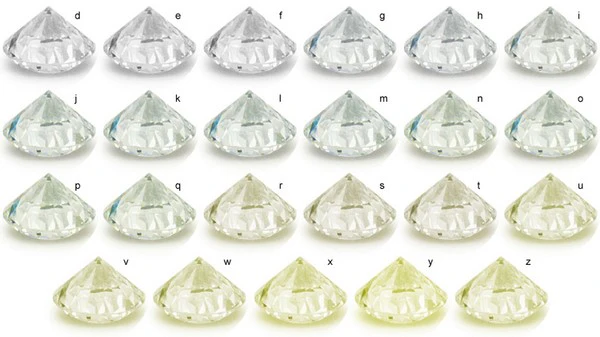
It is because it is difficult for a non-expert to distinguish color shades that we group diamonds by color family, as shown below.
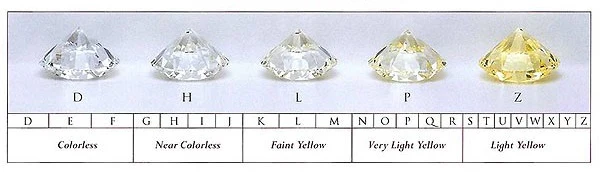
This color scale used by the GIA classifies diamonds into 5 color families ranging from perfect white to light yellow.
Note: Colored diamonds, also called fancy diamonds, are not graded according to this scale.
3. Clarity indicates the degree of imperfection of the diamond
All diamonds have imperfections. These imperfections are inclusions at the heart of the diamond’s structure that appeared during its formation.
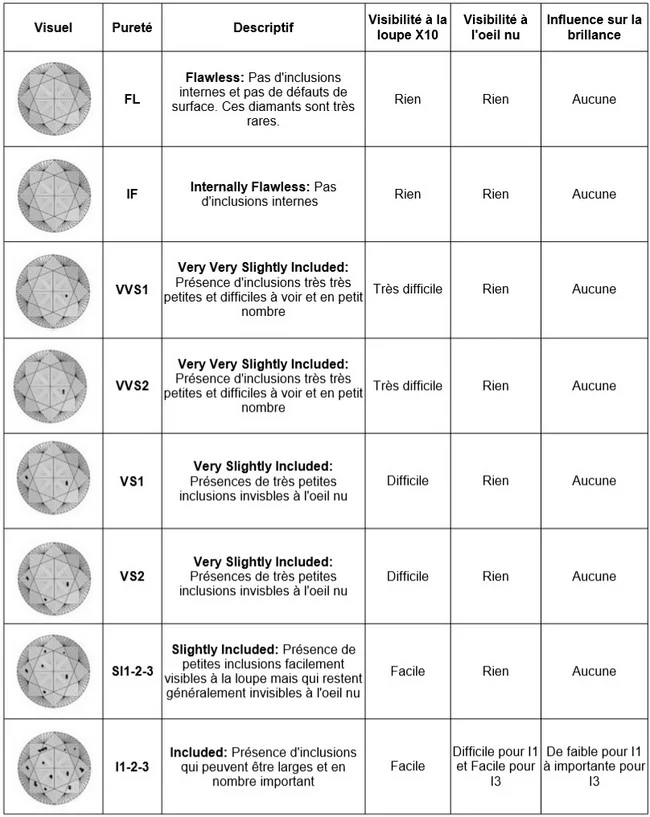
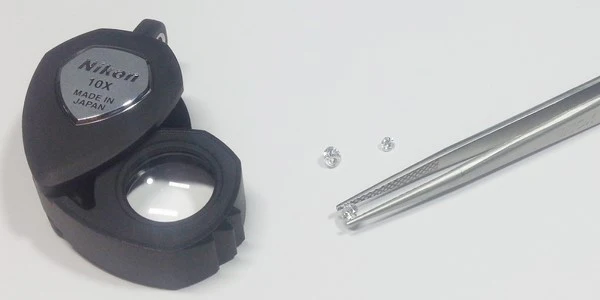
The determination of the clarity of a diamond is carried out under a special light with a magnifying glass of X10. So when we talk about impurities we need to know what we are talking about because in most cases they will not be visible to the naked eye nor will they affect the brilliance of the diamond.
Here is a classification table of diamonds based on their degree of purity
4. The quality of the diamond cut greatly affects its brilliance
The diamond can take on numerous geometries to enhance its brilliance and make the most of the rough diamond extracted from the mine. The round cut and the princess cut are the most used in jewellery. Here are the most common life forms:

It is the quality of the diamond cut (whatever its shape) that will maximize its brilliance. It is the only one of the 4 diamond evaluation criteria that depends on human work. In fact, a wrong cut can generate an excessive loss of rough diamond or not make the most of its brilliance.
The diagram below summarizes well what a well-cut round diamond is and the importance of these proportions for maximum brilliance, the path of the light directly depends on the quality of its cut.

The scale for classifying diamonds based on the quality of their cut is as follows:

5. The diamond guarantee certificate
Starting from a certain price or a certain weight (which varies from 0.3 to 0.5 carats depending on the jewelers) a diamond guarantee certificate is delivered at the time of purchase.
This certificate is established by an independent laboratory that evaluates the quality of the diamond sold according to the 4C rule.
The most famous of these gemological laboratories is the GIA, of which here is an explanatory video on reading the reports they provide with the diamonds they certify.
To go further:
latest posts published

Moonstone in jewelry

Engraving of men’s signet rings
Diamond clarity: inventory of natural inclusions

Creation of a Chrisme Medal in 18K Gold

18k gold men’s necklace (handcrafted)
Recycle 800 silver into pure silver

Large 18k solid gold bracelet

18k gold chain pendant

the history and symbols behind the Mo signet ring
