
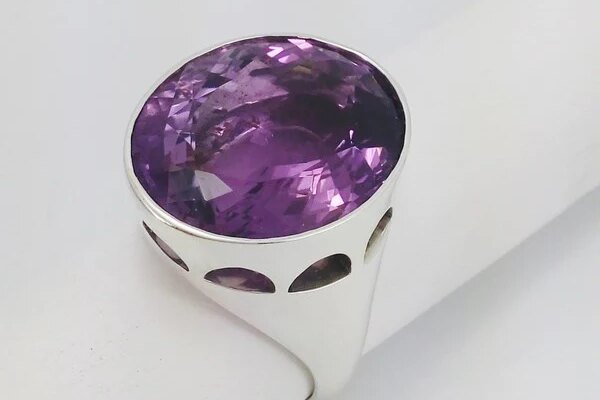
Episcopal rings are part of the ecclesiastical attributes of bishops who wear, in addition to the ring, an episcopal pendant.
These religious attributes visible and authorized by the Catholic Church have evolved over time.
While ecclesiastical rings have been discreet since the Second Vatican Council, they are traditionally decorated with a precious stone, the most common being amethyst.
We present here the creation of a large silver bishop’s ring with amethyst stone cut.
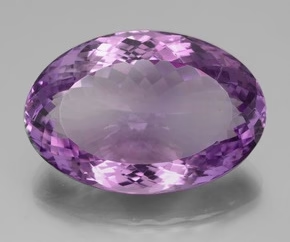
An overhead view of the amethyst stone in our ring, made via our online design service
Since ancient times, ecclesiastical rings have been worn by members of the clergy, a symbol of faith, devotion and cultural heritage transmitted from generation to generation and well represented by the fisherman’s ring worn by the Pope.
It is therefore not surprising that even today we regularly have the opportunity to produce Catholic religious jewelery and rings on behalf of our customers, as these few examples demonstrate.
Here are some examples of gold signet rings for men in religious style or with amethyst stone from our collection of signet rings for men
The signet ring design
Unlike the classic designs of solid silver men’s signet rings in our collection, this is a large men’s signet ring with a finger size of 75 on which is mounted an equally large amethyst of 36.84 carats measuring 26 x 21 millimeters.
Digital sketches of this project are produced following our client’s recommendations in order to obtain a CAD model of the project, allowing us to validate the design and proportions of the stone with the ring.
Openwork ring with large amethyst set
Obtaining this digital model allows us to give our client a good overview of the final rendering of their ring without running the risk of misunderstandings about its design.
Once the design has been validated, a 3D print of the digital model allows you to obtain a wax model of the ring.
Creation of the silver episcopal ring
On this ring we can mount the amethyst stone in white to ensure the ring size is correct in the setting.
The amethyst stone mounted rough on the wax model of the ring
We can then, using the lost wax casting process, create our silver ring.
To do this we make a refractory plaster mold containing our wax model, wax which is then cooked in an oven in which the mold is placed.
Once this is done, the molten liquid silver can be poured into the mold.
Here is a video summary of the phases of this process.
This gives us our raw foundry silver ring.
We can then mount our amethyst stone in white to visualize the adjustments necessary for the correct setting of the stone.
View of the amethyst stone placed on the rough cast silver ring
We then have to carry out the retouching, polishing and setting of the amethyst to obtain this result.
View of the amethyst signet ring in its case
Other creations of similar ring projects with other stones set, these projects were obviously also made in our laboratory:
To go further:
latest posts published

Moonstone in jewelry

Engraving of men’s signet rings
Diamond clarity: inventory of natural inclusions

Creation of a Chrisme Medal in 18K Gold

18k gold men’s necklace (handcrafted)

Large 18k solid gold bracelet

18k gold chain pendant

the history and symbols behind the Mo signet ring

Rolex: a brand that has become essential
