
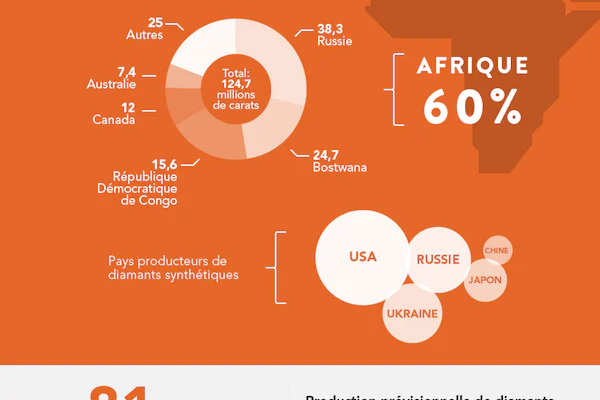
At the beginning, synthetic diamonds were mainly intended for industry. With technological advances in recent years, their quality is now equal to natural gems, to the point that it is impossible to distinguish them with the naked eye.
But the arrival of synthetic diamonds on the jewelry market poses a threat to Africa, which is largely absent from this developing market.
In addition to being cheaper, synthetic diamonds have the advantage of never having been contaminated by blood and armed conflict. They could therefore appear as the ideal alternative to diamonds and the bloody image associated with them.
But we can safely say that synthetic diamonds are not the solution.
“What is rare is expensive”
With production estimated at 20 million carats by 2026, synthetic diamonds could disrupt the diamond market.
The value attributed to a diamond depends on its rarity.
Therefore, the arrival of synthetic diamonds on the market could lead to a general decline in diamond prices and the end of the social prestige granted to them.
The drop in prices of rough diamonds was 15% in 2015. A drop of great impact for African countries dependent on the diamond trade.
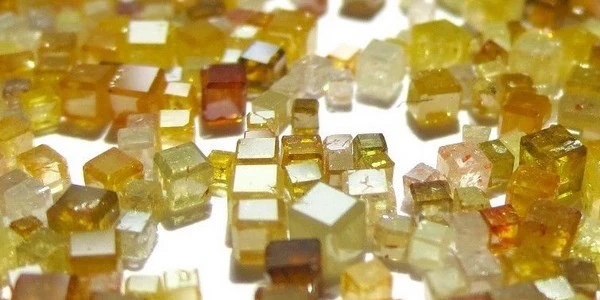
Polished rough cubic diamonds
The arrival of synthetic diamonds: what impact for Africa?
The topic of conflict is often raised when talking about synthetic diamonds, which we are sure are guaranteed “conflict free”.
But it should be known that since the establishment of the Kimberley Process, the share of conflict diamonds in world production is estimated at around 0.2%, compared to almost 15% in the late 1990s. The problem of conflict diamonds is therefore smaller than it was 15 years ago.
Furthermore, producing 60% of the world’s production of rough diamonds, Africa derives numerous profits from this market, a source of stability and development for many regions. This business brings in approximately $8.4 billion per year. A significant sum for the social and economic development of the continent.
1.10 carat blue cubic rough diamond
However, to date, Africa is largely absent from the synthetic diamond market. If the latter were to become more democratic, the consequences for the economy of African producing countries could be harmful: fall in diamond prices, decline in export earnings and taxes on multinationals, loss of jobs, etc.
Enough to shake their still often fragile stability!
Because if we often hear about blood diamonds and «illegal» diamonds financing armed groups in Africa, it completely obscures the fact that diamonds are a mineral resource which, if well managed and exploited correctly, can contribute to the development of exploiting countries.
This is particularly the case in Botswana which we describe in detail below.
Favorable impacts of a controlled diamond economy
Diamonds play an important role in the African economy. And as long as it is well organized and valued in the official economy, its benefits can be numerous, both economically and socially.
Botswana is the perfect example of a possible non-violent and peaceful development of the diamond industry in Africa.
The political stability that the country has experienced since its independence in 1966, its prudent budgetary policy and its management choices in the mining sector have allowed it to prosper rapidly and for decades thanks to the export of diamonds.
Profits reinvested at the service of the country’s development
The government of Botswana invested mining revenues in improving the economic situation and social conditions of the country: building infrastructure, creating a healthcare system, creating a free education system, etc.
Debswana Employee Benefits – diamond mining company in Botswana 50-50 owned by De Beers and the Botswana government – compared to other sectors, the following are also interesting: higher minimum wage, health insurance, pension fund and free accommodation in semi-detached houses…
A still relatively unusual vision of mining work that should serve as an example to other countries.
0.13 carat SI2 pink diamond
Strong dependence of the economy on the diamond sector
Botswana’s GDP growth was around 8% per year until the late 1990s, placing it among the most prosperous economies in the world. The diamond industry is the main driver of this growth and the state-led development strategy. But the decline in demand for diamonds in 2009 threatened the previously stable economic model and highlighted the economy’s over-reliance on the mining sector.
This growth driven by diamonds and these investments for the social development of the country must be contrasted with other realities:
Botswana is among the worst ranked countries in terms of income inequality, has the second highest HIV/AIDS prevalence rate among adults, and its Human Development Index has worsened.
To go further:
latest posts published

Moonstone in jewelry

Engraving of men’s signet rings

Diamond clarity: inventory of natural inclusions

Creation of a Chrisme Medal in 18K Gold

18k gold men’s necklace (handcrafted)

Large 18k solid gold bracelet

18k gold chain pendant

the history and symbols behind the Mo signet ring

Rolex: a brand that has become essential
