
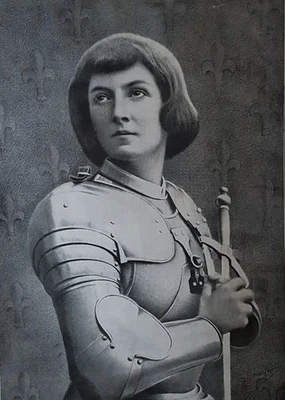
Joan of Arc he is one of the most significant figures in French history. Born into a peasant environment, without wealth or education, she played, over the course of two years, a decisive role in the context of the Hundred Years’ War, before meeting a tragic end at the stake. Condemned, executed, then rehabilitated, she was finally canonized several centuries later.
Yet although her story is that of a young 15th-century woman, Joan of Arc is one of the best-documented medieval figures, largely thanks to the exceptional archives of her trial. These sources allow us to precisely distinguish the established facts from what subsequent generations have gradually built around his image.
Having become a symbolic figure whose reach transcends time and borders, Joan of Arc thus invites us to carry out an essential work of distinction: understanding what History establishes and what myth, over the centuries, has shaped.
Ancient engraving of Joan of Arc, signed G. Morinet
INDEX
- Historical facts: a young woman at the center of a real conflict
- The trial: a political condemnation, a great historical dossier
- What the myth has built: from historical figure to icon
- Between history and myth: why the distinction is essential today
- Joan of Arc: a stronger figure when we distinguish reality from myth
1. Historical facts: a young woman at the center of a real conflict
Joan of Arc He was born around 1412 in the village of Domrémy, to a peasant family. Her public life was extremely short (just two years) but she is known with rare precision for a medieval figure.
This singularity is due to the nature of the preserved sources: contemporary testimonies, chronicles and above all the detailed minutes of his trial. These documents allow us to retrace his journey without resorting to legend, providing access to his words, his choices and his behavior towards the authorities of his time.
A well-identified political and military context
Joan of Arc’s action took place at a critical moment in the Hundred Years’ War. The kingdom of France was then profoundly weakened: part of the territory was occupied, the legitimacy of the dauphin Charles was contested, royal power struggled to assert itself.
Joan appears in this context as a figure of moral and political support, driven by the conviction of a mission at the service of the kingdom. His intervention accompanies an important symbolic turning point, in particular during the coronation of Charles VII, without changing only the military balance of the conflict.
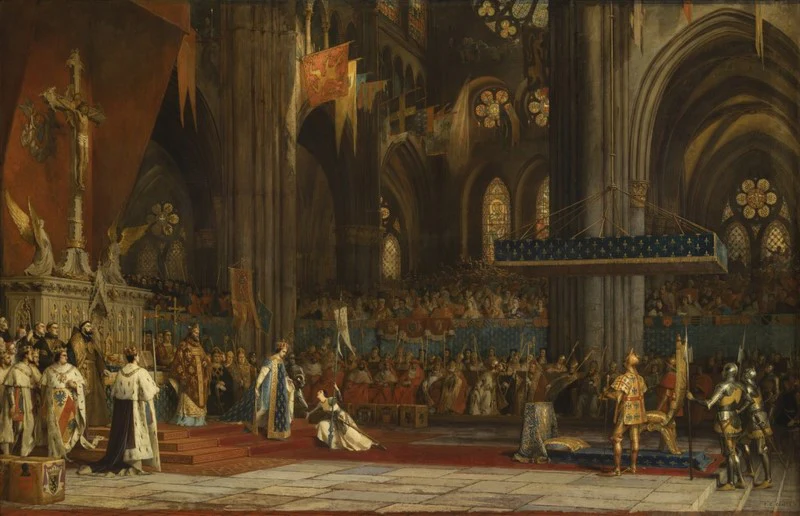
Joan of Arc at the coronation of Charles VII, 17 July 1429. Painting by Pierre-Charles CONTE, 1861
A real role, between symbolic presence and concrete action
Contrary to some late representations, Joan of Arc is neither a military leader in the strict sense nor a simple decorative figure. He does not command armies, but actively participates in campaigns, shares the living conditions of the soldiers and exercises a decisive moral influence.
His role is based on words, conviction and coherence between his actions and his faith. It is precisely this intermediate position that gives his action a singular historical meaning.
2. The trial: a political condemnation, a great historical dossier
After his capture in 1430, Joan of Arc he was handed over to the English authorities and imprisoned in Rouen. His trial began in 1431 before an ecclesiastical court in a context of strong political pressure. The judges are linked to the English camp and guarantees of independence are non-existent. The goal goes beyond Joan alone: it is also about discrediting the legitimacy of the king she helped crown.
Answers that reveal great mastery
The trial records constitute exceptional testimony. They precisely record the questions asked of Jeanne and her answers, often developed under duress. Far from the image of a naive or manipulated young woman, these exchanges reveal a real capacity for analysis and great caution in the use of words.
When questioned about her spiritual state, a question destined to place her in a theological dead end, Joan responds in a balanced manner, rejecting both proud affirmation and admission of guilt. This response, recognized by his judges as skillful, demonstrates his understanding of the issues at stake in the trial.
On several occasions he is also in a hurry to deny what he claims to have received as a mission. Joan recognizes the authority of the Church, but believes she cannot renounce what she believes has been ordered to her by God. She thus establishes a hierarchy of obedience which, without being provocative, remains irreducible for her accusers.
Finally, in the last days of the trial, faced with the concrete threat of execution, the facts show a young woman aware of the danger, who expresses fear and fatigue, but refuses to deny herself. This consistency is neither mechanical nor exalted: it appears like an obvious choice, despite the pressure.
Original register of the trial of Joan of Arc from 1431, preserved in the National Library of France
Conviction, execution and rehabilitation
Convicted of heresy, Joan of Arc was executed in May 1431. Her death brutally ended a journey already full of meaning. However, this verdict does not constitute a definitive result. In 1456 a rehabilitation process officially annulled the initial sentence, recognizing the major irregularities of the first trial.
This double moment (conviction and then rehabilitation) gives the trial of Joan of Arc a central place in history. It is not just a judicial event, but an important historical document, which sheds light both on the reality of his existence and on the mechanisms that led to the progressive transformation of his figure into a lasting symbol.
Original register of Joan of Arc’s rehabilitation process from 1456, preserved at the National Library of France
3. What the myth has built: from historical figure to icon
After his death, Joan of Arc it does not disappear from the collective memory. His conviction, then his official rehabilitation in 1456, definitively fixed his fate in the archives. From there, his story ceases to be solely a fact of the past to become a story transmitted and interpreted according to the times. This transformation does not happen suddenly: it is gradual, fueled by news, literature, then art and historiography.
Handwritten note from Joan of Arc addressed to the inhabitants of Reims, 1429
From historical figure to symbolic figure
Over time, the history of Joan of Arc gradually transformed. Some elements of his journey (his modest origins, his determination, his loyalty to what he perceives as a mission, and his unjust death) have been highlighted, while others have faded. This movement is not based on falsification, but on simplification: a complex and nuanced reality becomes a more readable story, capable of being transmitted beyond its original context.
Since her existence is short, dense and interrupted, Joan of Arc establishes herself as a figure of collective projection. Depending on the era, she was seen as a national heroine, a model of courage, or a spiritual figure, and each reading selected certain aspects of her journey. Myth does not replace History; constitutes its extension. It is precisely because his existence is firmly attested by sources that his figure has been able to acquire a lasting symbolic meaning, spanning the centuries without losing its historical anchorage.
Photo showing the golden statue of Joan of Arc, installed on the Place des Pyramides in Paris
4. Between history and myth: why the distinction is essential today
Distinguishing history from myth does not mean contrasting reality and imagination, but understanding how a human path, solidly documented, was able to acquire a lasting symbolic meaning. This distinction allows us to grasp its richness Joan of Arc without fixing it in a single story.
Four fundamental differences between established history and the myth of Joan of Arc
- The myth presents Joan of Arc as the savior of Francewhile historical reality shows that he is integrated into a military, political and religious entourage, he therefore never acts alone
- The myth presents him as a victorious warriora strategist even if she is not a military leader and her role is mainly moral and symbolic
- While the myth presents it as endowed with unshakable faithwithout hesitation and without fear, the facts show that Joan of Arc expressed doubts, questioned her voices and sought the approval of the Church
- The myth purifies the historical violence of time to present it as a martyr
Having become a figure of collective memory, Joan of Arc breaks away from the patterns of her existence to become part of a shared cultural heritage. It is by maintaining the link between established facts and subsequent interpretations that its history can continue to be transmitted, understood and invested with meaning, without losing its historical anchorage.
5. Joan of Arc: a stronger figure when we distinguish reality from myth
The myth of Joan of Arc it is not based on inventions, but on the simplification and telling of a real, exceptional and solidly attested story. The facts are known, documented and verifiable; the myth does not contradict them. It makes them transmittable, memorable and understandable beyond their original context.
It is precisely this articulation between historical reality and symbolic construction that gives Joan of Arc her lasting strength: an authentic figure, whose true story has acquired universal meaning.
This distinction is part of a broader reflection on Joan of Arc’s place in history and collective memory, developed in our article dedicated to her history, her symbol and her legacy.
About the author
Nicolas Tranchant, entrepreneur and founder of Vivalatina, is interested in how some historical figures become lasting symbols. His approach combines cultural intuition and reflection on the transmission of values through memory objects.
latest posts published

Moonstone in jewelry

Engraving of men’s signet rings

Diamond clarity: inventory of natural inclusions

Creation of a Chrisme Medal in 18K Gold

18k gold men’s necklace (handcrafted)

Large 18k solid gold bracelet

18k gold chain pendant

the history and symbols behind the Mo signet ring

Rolex: a brand that has become essential
