

It is not possible to understand Joan of Arc without understanding the century in which she appears. Her gesture, her words and the way she was perceived acquire full meaning only in light of the political and religious context of the 15th century.
Looking at it through our contemporary concepts inevitably leads to misunderstandings. In the Middle Ages, power was sacralized, monarchical legitimacy was based on precise rituals and religion permeated all public life.
Before discussing battles or decisions it is therefore necessary to restore this historical framework. It is in this environment, full of tensions and marked by a crisis of authority, that Jeanne’s intervention takes on all its meaning.
For an overview of her journey and legacy, see our main article dedicated to Joan of Arc: Joan of Arc: History, Symbol and Legacy.
Miniature depicting Joan of Arc riding past Orléans, by artist Jean Pichore, dating from 1504-1506
INDEX
- A Kingdom in Crisis: The Hundred Years’ War at its height
- A divided kingdom: Armagnacs against Burgundians
- The religious dimension of power in the fifteenth century
- Orleans, 1429: a turning point
- Real political problems of Jeanne’s intervention
- Understanding Joan in her century
1. A Kingdom in Crisis: The Hundred Years’ War at its height
When Joan of Arc entered history in 1429, the Kingdom of France had been engaged in the Hundred Years’ War (1337-1453) for almost a century. This dynastic conflict between the French and English crowns cannot be reduced to a succession of battles: it profoundly disorganized the territory, weakened royal authority and established a lasting climate of political uncertainty.
At the beginning of the 15th century the situation was particularly unfavorable for the French camp. Military defeats, including that of Agincourt in 1415, did lasting damage to the prestige of the nobility. Large portions of the kingdom’s north fell outside the Dauphin’s direct control, while Paris was under Anglo-Burgundian influence. War is no longer just a feudal rivalry; it becomes a question of sovereign legitimacy and the very existence of real power.

A map of the kingdom circa 1429 illustrates the political fragmentation of the territory
In this context of extreme fragility, every victory or defeat takes on an important symbolic dimension. The conflict therefore reached a decisive phase: not only for the military balance, but for the very definition of what the kingdom of France is and who has the right to govern it.
2. A Kingdom Divided: Armagnacs vs. Burgundians
At the beginning of the 15th century an internal division divided the kingdom. It originates in 1407, with the assassination of Louis d’Orléans, brother of King Charles VI, by order of John the Fearless. This murder marks the transition from a political rivalry to an open clash between two factions: the Armagnacs, close to the party of Orléans, and the Burgundians, loyal to the Duke of Burgundy.
In the following years the conflict degenerated into a real civil war. Paris is becoming an important strategic issue. In 1418 the Burgundians conquered the capital; The Armagnac partisans are arrested and executed. The dolphin must escape and retreat towards the center of the kingdom. The royal authority now appears fragmented, incapable of imposing unity.
The situation worsened further in 1419 when John the Bold was murdered during a parley with the Dauphin. His son, Philip the Good, then chose to openly ally himself with England. This decision seals the convergence between civil war and foreign war: the kingdom finds itself involved in a double confrontation, internal and external.

Miniature showing the assassination of Jeans-sans-peur on the bridge of Montereau, 10 September 1429. Author, Enguerrand de Monstrelet (BnF)
In 1420, the Treaty of Troyes ratified this division by eliminating the Dauphin from the succession in favor of the King of England. In the early 1420s two rival authorities effectively coexisted: the north of the kingdom under Anglo-Burgundian influence and the camp of the future Charles VII of France entrenched south of the Loire.
When Joan of Arc appears on the public stage, she intervenes in a kingdom that is not only invaded, but deeply divided. The restoration of monarchical legitimacy therefore requires the resolution of this internal division as much as the repulsion of the external enemy.
3. The religious dimension of power in the fifteenth century
In the 15th century, political power was not understood independently of religion. The French monarchy is based on a sacred concept of authority: the king is not just a military leader or an administrator, he is seen as invested with a divine mission. This theological dimension establishes the legitimacy of the sovereign and structures the collective imagination of the kingdom.
The coronation occupies a central place in this regard. Celebrated in the Notre-Dame cathedral of Reims, it is not a simple symbolic ceremony, but a founding act. With the anointing, the king becomes God’s lieutenant on earth; receives a consecration that goes beyond the dynastic inheritance. Without a coronation, legitimacy remains incomplete, even questionable.

Engraving depicting the coronation of Charles VII at Reims on 17 July 1429
In a profoundly Christian society, signs perceived as divine do not belong to the private sphere. They are part of a culture in which the spiritual informs public and political life. The great decisions and the conflicts themselves are interpreted in the light of a providential reading of history.
Understanding this close link between faith and power is essential to restoring the logic of time. In the 15th century, royal authority was not based exclusively on force or dynastic law: it was rooted in a sacred conception of government, where religion participated fully in the definition of politics.
4. Orleans, 1429: a turning point
In the spring of 1429 the conflict reached a critical point. The siege of Orléans has lasted for several months and threatens to open access to the south of the kingdom to the English. The city constitutes a strategic lock on the Loire: its fall would permanently compromise the Dauphin’s position and further weaken its legitimacy.
It is in this context that Joan of Arc joined the French army. His arrival does not instantly transform the military situation, but it profoundly changes the psychological dynamics of the French camp. It is part of a strategy already prepared by expert captains; however, its presence acts as a factor of cohesion and mobilization.
Within a few days several English positions were taken and the siege was lifted in May 1429. This victory did not end the war, but broke a spiral of defeats and restored confidence in the Dauphin’s party. Above all, it paves the way for a rapid campaign along the Loire, making it possible to predict what had hitherto seemed uncertain: the coronation at Reims.

Miniature depicting the fighting during the siege of Orléans 1428-1429, from the work The vigils of Charles VIImanuscript by Martial d’Auvergne, circa 1484
Orléans therefore marks a turning point not so much on a military level but on its political significance. The lifting of the siege transforms an unfavorable balance of power into a concrete possibility of monarchical restoration. From this moment, the idea of a legitimate king consecrated according to the traditional rite ceases to be theoretical: it becomes an achievable goal.
5. The real political issues of Jeanne’s speech
Joan of Arc’s action cannot be understood exclusively from a military perspective. The victories of 1429, and especially the coronation of Charles VII of France at Reims, produced far more profound political effects than the simple movement of a front.
The first question is that of legitimacy. Since the Treaty of Troyes, dynastic succession has been legally contested. By allowing access to the coronation, Joan’s intervention contributes to restoring a monarchical continuity that had been called into question. The king is no longer just a pretender entrenched south of the Loire; he becomes a sovereign consecrated according to the traditional rite, recognized by a growing part of the kingdom.
The second issue concerns the internal balance of forces. In a context of civil war between the Armagnacs and the Burgundians, the dynamics created in 1429 changed the balance of power. Military successes and the coronation encourage demonstrations, strengthen the position of the royal camp and gradually isolate its opponents. Jeanne’s intervention thus serves as a political accelerator in a fragmented kingdom.
Its role goes beyond military strategy alone: its action transforms the perception of the conflict. Where doubt and uncertainty reigned, the idea of a restoreable monarchical legitimacy was reactivated.
Thus, in a few months, the question is no longer whether the legitimate heir will be able to reign, but how to strengthen a power that has become credible again.
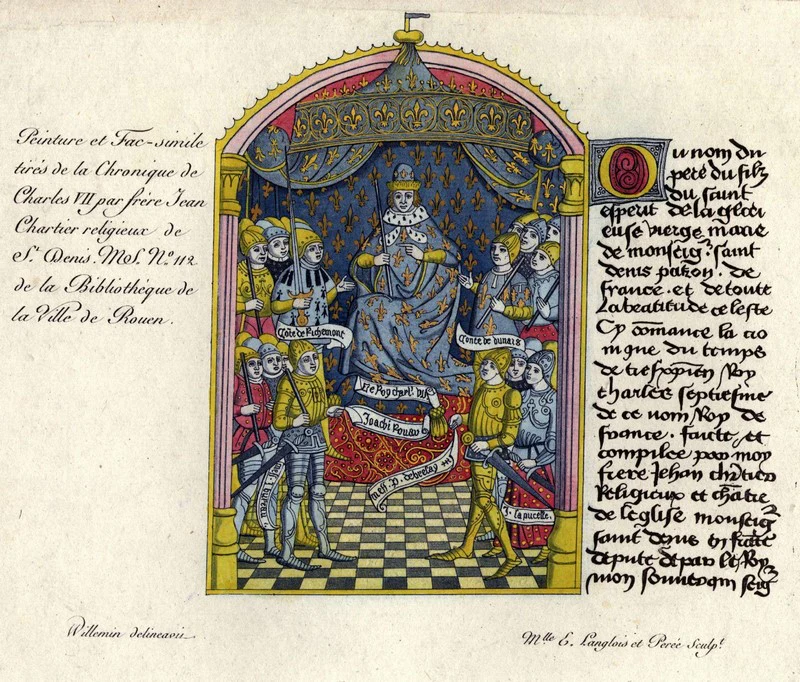
Representation of Charles VII, after his coronation, with all the possessions of the divine king, giving him the status of legitimate king
6. Understanding Joan in her century
To understand Joan of Arc it is necessary to place her in the context of the 15th century: a kingdom weakened by the Hundred Years’ War, crossed by a civil war between rival factions and marked by a profound crisis of monarchical legitimacy. Added to these political and military tensions is a religious conception of power in which the coronation establishes the king’s authority.
In this context, his intervention is placed in a specific context, at the crossroads of dynastic issues that oppose two crowns. It takes on meaning because it responds to the expectations and beliefs of its time.
Understanding him in his century means avoiding anachronisms and restoring the logic of a world where politics and religion are inseparable. It also means recognizing that the extent of one’s commitment is due as much to the context that made it possible as to the uniqueness of one’s path.
This distinction between established facts and subsequent constructions will be explored in depth in our article dedicated to what History establishes and what myth has built around Joan of Arc.
About the author
Nicolas Tranchant, entrepreneur and founder of Vivalatina, is interested in how some historical figures become lasting symbols. His approach combines cultural intuition and reflection on the transmission of values through memory objects.
latest posts published

Moonstone in jewelry

Engraving of men’s signet rings

Diamond clarity: inventory of natural inclusions

Creation of a Chrisme Medal in 18K Gold

18k gold men’s necklace (handcrafted)
Recycle 800 silver into pure silver

Large 18k solid gold bracelet

18k gold chain pendant

the history and symbols behind the Mo signet ring
