
Gold is the only known metal naturally with a very pronounced yellow color. Even when it is not pure, it is difficult to change its color.
Known to humans for over 6,000 years, gold has been the basis of all global economies since ancient times.
Pure gold is yellow, shiny and unalterable. It has therefore fascinated man since he discovered it and even today 24 karat gold is used not only for the manufacture of jewelery but also for investors and as collateral for banks around the world.
Among the three precious metals present in jewellery, gold is the most widespread and the most coveted. Even though the price of platinum used in jewelry sometimes exceeds that of gold, everyone knows about gold and knows that it can be bought or sold very easily in the four corners of the world.
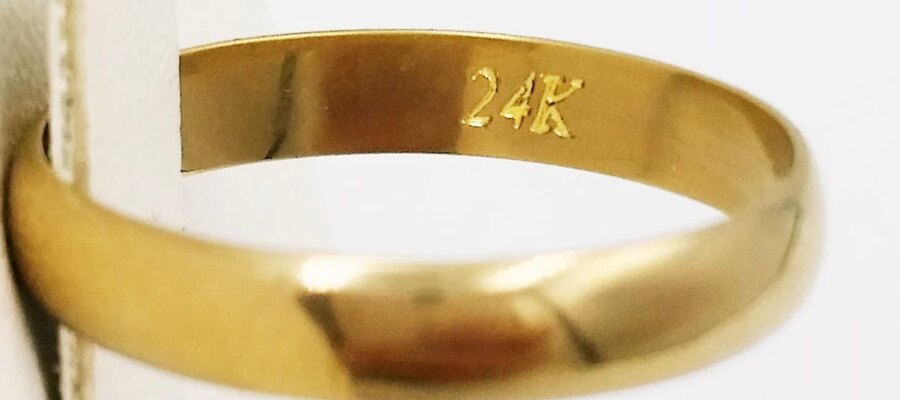
24k gold ring bearing the 24k mark affixed by the jeweler of the Vivalatina team. Check out our full collection of 24K gold jewelry in our American store
INDEX
- What is pure gold?
- What is karat gold?
- gold price in carats
- How is pure gold obtained?
- Advantages and disadvantages of pure gold for jewelry
- Pure gold rings and chains
- The future of 24k gold jewelry
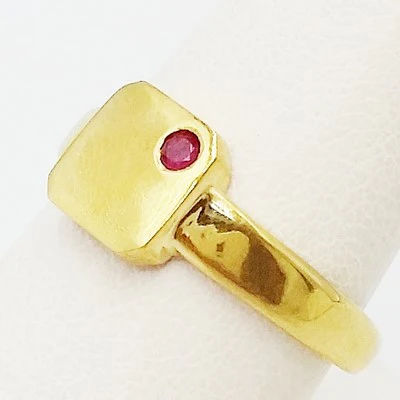 |
karat gold jewelry from the Vivalatina US collection
1. What is pure gold?
By definition, pure gold must contain at least 99.9% gold by weight. Pure gold is also called fine gold, it is gold without any other metal mixed.
This type of gold is also called:
- 999 Gold or called 3-9 Gold
- O 24k / O 24k
There are industrial processes to obtain 99.9% pure gold, as we will see later.
Characteristics of fine gold
Before being a precious metal, gold has numerous unique properties that distinguish it from other metals:
- It is naturally pure (or almost) yellow in color (even when not pure) in the form of nuggets or associated with other metals
- It is a very dense metal with a density of 19.5 when gold is pure, which allows it to separate easily from other lighter elements.
- It is the most malleable of all metalswhich facilitates manual or mechanical work to shape it.
- It is very flexiblemeaning that one ounce of gold (31.10 grams) can be stretched into a wire more than two kilometers long. For this reason it was used to mint coins.
- It is unalterable, that is, bases and acids do not attack it. This makes gold very resistant to air and even exposure to chemicals.
- It dissolves easily with a melting point of 1064°C
- Its electrical and thermal conductivity properties make it useful for the electronics industry.
- It shines strongly when polishedwhich explains its use in jewelry.
- It’s rare with an average concentration in the earth’s crust of 0.004 grams per ton of rock.
- Gold dissolves only in aqua regiawhich is a mixture of nitric acid and hydrochloric acid.
This photo shows the pronounced yellow color of pure 24k gold compared to platinum on the left (see our platinum guide) and pure silver on the right
Where does gold come from?
Although gold is mined underground, it was not formed on Earth, unlike diamonds and other precious stones which are produced by complex chemical processes that occur deep within the Earth.
Gold was formed in space, thanks to the synthesis of stellar nuclei. The current state of science suggests that when a star explodes in a supernova, the star’s iron core is subjected to a neutron flux large enough to transmute the iron atoms into heavier atoms, including gold, platinum, and silver.
Remember that the atomic number of gold is 79 while that of iron is 26.
The gold thus formed was dispersed into space and mixed with the mass of protoplanetary gas that would later form our solar system and the Earth. Gold is therefore a priori present everywhere on Earth, but its density and its tendency to bind to iron mean that terrestrial gold is essentially concentrated in the heart of our planet.
Yes, most of the Earth’s gold is not found on the Earth’s surface but at its core.
The geochemical and magmatic activity of the Earth’s crust allows gold buried beneath the Earth’s crust to reach the surface to be found or mined.
Today gold is extracted from open pit mines. Rocks are quarried and processed industrially to extract metals, including gold, using a variety of complex chemical processes.
It is estimated that for industrial mining of the gold mining site to be profitable, a gold concentration of at least one gram of gold per tonne of rock is required.
karat gold jewelry from the Vivalatina US collection
2. Explanation of gold carats
As we have seen, pure gold (999 gold) is 24 karat gold.
Do you know what a carat is?
The etymological origin of the jewelers’ carat comes from the word «Quirat», which is an ancient maritime term that expresses participation in the ownership of a ship when it belongs to more than one person.
The ship is divided into 24 parts of equal value (“a quirat”) and each has a certain number of “quirats”, which express the percentage of the shares of the ship that each of the investors owns.
Therefore, the gold karat expresses how many of the 24 parts of the metal are pure gold.
Attention
The carat of a precious stone expresses a weight of 0.2 grams. It is different from the gold karat which expresses a proportion (percentage).
Why mix gold with other metals?
As with all metal alloys, the goal is to improve the properties of the base metal.
Gold is a noble metal with many advantageous properties but in its pure state it is poorly resistant to impacts and scratches.
As a result, a thin piece of pure (24 karat) gold jewelry would easily deform due to a small impact. This is why we tend, when making 24k gold jewellery, to give them a thick and solid design to compensate for the malleability of the metal and to be able to resist impacts.
The different carats of gold
It is to enhance the natural qualities of gold that pure gold is mixed with other metals. The most common gold alloys are:
- Or 18 carats : 18K gold (75% of its weight in pure gold) is the most valuable of the solid gold alloys used in conventional jewelry
- Or 14 carats : 14-karat gold (58.4% of its weight in pure gold) is the most common because it is much cheaper than 18-karat gold and maintains a yellow color very similar to it
- Or 9 carats : 9K gold (37.5% of its weight in pure gold) is the cheapest gold alloy on the jewelry market, more than half of its weight is non-gold
There are many more possible alloys for gold, this graph shows you the correspondence between carats and percentage of fine gold in the metal:
This table shows you the correspondence between the carat weight of gold and the percentage of pure gold present in this alloy
karat gold jewelry from the Vivalatina US collection
3. Price of 24 karat gold
The price of the precious metal is always expressed per 24 karat gold and varies daily. This graph shows the evolution of the price of pure gold since 1900.
As we can see, gold does not lose value in the long run. Pure gold is not an asset and is not considered profitable to hold compared to assets such as businesses. But in times of economic crisis, 24 karat gold continues to be the best economic guarantee for preserving liquidity.
4. How is pure gold obtained?
24 karat gold is theoretically 100% pure gold.
Currently there is no 100% pure gold. Depending on the natural deposits, it is possible to find pure native gold of 22 or even 23 carats, i.e. 91 or 95% pure.
Several chemical processes have been discovered to refine and concentrate gold. The most common is the so-called Miller process, which produces gold with a purity of 99.95%. It is the common pure gold from which gold bars are made. This type of pure gold is called 3-9 (999) gold.
The purest gold that can be produced today is obtained through the Wohlwill process, which produces 99.999% pure gold. Few refining sites are capable of implementing such a treatment process. The Royal Canadian Mint is known for using this gold refining process to produce pure gold bars and coins. This type of pure gold is called 5-9 gold.
karat gold jewelry from the Vivalatina US collection
5. Advantages and disadvantages of pure gold for jewelry making
Pure gold has an incomparable yellow color and its density gives considerable weight to the jewel. This is why it is common for some men to want their jewelry to be made of pure gold.
If the advantages of fine gold are evident in aesthetic terms, 24 karat gold has disadvantages for your jewellery:
- Because they are very malleable, jewelry needs to be thick to be more durable.
- Since the metal is very dense, these jewels weigh a lot and are expensive in terms of metal price.
- Polishing 24k gold is difficult for the jeweler to achieve and the metal marks easily, losing its luster over time
- Fine gold is not suitable for setting claw stones, which limits the jewelry designs that can be made with it.
Considering these points, some jewelry designs can be made of 24k gold if you have the budget for this type of jewelry.
6. Pure gold rings and pendants
With the right design you can create many pure gold jewels as shown in these examples of rings, wedding rings, earrings, pendants…
karat gold jewelry from the Vivalatina US collection
7. The future of 24K gold jewelry
While pure gold jewelry is rare in the West, it is very common in Asia. For centuries, Chinese people in particular have sought out 24-karat gold jewelry because it offers an unmistakable color, serves socially to demonstrate their status and also because it can be sold at any time anywhere in the world if necessary.
For this reason, in Asia there are jewelers specialized in the production of pure gold jewelery that have developed modern techniques to create light and durable pure gold jewellery.
This process is known as hard gold electroforming and involves depositing thick layers of gold onto a wax mold using computer-controlled electrical currents. This process is very similar to the gold electrolysis process used to make gold plating, but produces thicker layers of gold ranging from 0.1 to 0.3 millimeters in thickness.
Here are the main advantages of this gold electroforming process:
- Jewelry can be made with 24k gold
- Fine, complex and hollow shapes can be made
- Large, lightweight parts can be produced
- It allows the industrial production of multiple parts at the same time, reducing production costs
- This process does not generate any waste or loss of metal, unlike artisanal production processes
With this new process, which is more environmentally friendly and offers better control of the purity of the gold deposit, combined with advantages in terms of wear resistance, the main 24 karat gold jewelery manufacturers in the Asian market are targeting the American market to develop their sales.
To go further:
latest posts published

Moonstone in jewelry

Engraving of men’s signet rings
Diamond clarity: inventory of natural inclusions

Creation of a Chrisme Medal in 18K Gold

18k gold men’s necklace (handcrafted)

Large 18k solid gold bracelet

18k gold chain pendant

the history and symbols behind the Mo signet ring

Rolex: a brand that has become essential
