
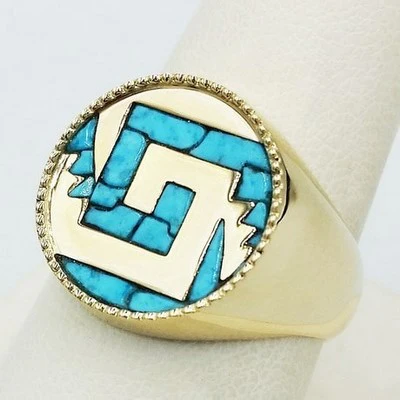
This year’s fashion is an opportunity to see Aztec symbols flourish on every possible accessory that fashion can touch, and we are seeing Aztec motifs flourish almost everywhere that no longer have much to do with historical motifs.
The representation of motifs we see is often simplistic and stereotypes Aztec culture in frescoes composed of squares and triangles. As we will see, Aztec representations were much richer than this.
We accompany you to learn more about Aztec motifs and their meaning. The latter, after having saturated the fashion prints of the clothes, would be on the verge of disappearing from the shops for some time, perhaps allowing people to rediscover the authentic Aztec symbolic expression.
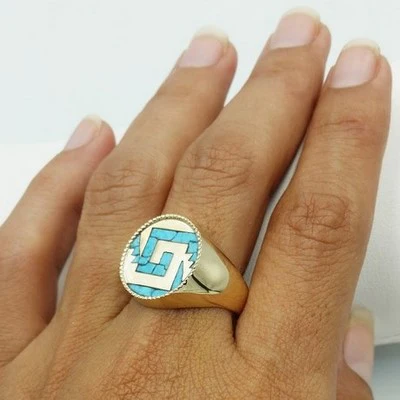 |
Aztec motifs had very strong spiritual symbolism. In the case of this ring, the gold Greek stone represents the sun and the warrior spirit intertwined in the turquoise blue Greek stone which represents water and therefore life. This video shows the steps to make such a ring.
Patterns with astronomical meaning
The vast majority of Aztec graphics depict deities, animals (related to deities), or motifs with religious significance. Aztec writing consisted of glyphs that represented a sound, a word, or even a letter. The latter were accustomed to using symbology to express messages, whether on walls, on codices, on religious artefacts or in everyday life.
This symbolism allowed a message to be expressed while being decorative, a function for which Aztec motifs are so widely used today.
The social life of the Aztecs revolved around religion linked to the stars, all the motifs present on ceramics or decorative objects are linked to their astronomical interpretation of the stars and the sky that they could observe.
Aztec ceramic covered with motifs of astronomical references
A range of Aztec representations
Here is a presentation of the motifs most frequently found by archaeologists and the interpretation given to them.
The Aztecs represented the sun with a flower of different shapes.CYes, the flower was the symbol that evoked the precious:
This design represents the full, motionless sun, it is characterized by concentric circles in the center and the flower petals represent the rays of the sun. We note that the representation was not fixed and varied depending on places and times, which complicates the work of linguistic and archaeological researchers.
This represents the full sun in motion during the day, characterized by its center composed of a spiral.
The half flower represents the sun at sunrise or sunset.
The flower with the center in the shape of a broken spiral represents the sun in relation to the world inhabited by men.
This four-petalled flower represents the four directions of the universe delimited by the 4 days that mark the solstices. Another interpretation given is that it represents the four directions of the world and its center.
This split spiral represents the path of the sun during the day and throughout the year. Archaeologists have called this pattern “the shape of the year.” Sometimes we find a similar pattern on pottery, resembling this same pattern cut in two and folded back on itself.
Representation of the day composed of a spiral divided into two equal sections representing day and night.
Like all Aztec motifs, this one often varies depending on the representations. This spiral and ladder pattern is associated with what is above, the movement of the sun, sky, clouds and rain.
This sturdy, spiral staircase-shaped design represents the world below, the path of the sun during the night as it travels through the underworld, the night, the darkness and the cold.
Model that marks the four directions of the universe and also the four solstices of the year crossed by the sun and the center, the center of the world, where the Aztecs live.
These wavy, intertwined bands could represent the alternation of day and night or sometimes, depending on the associated glyphs, they could represent a semester from the winter solstice to the summer solstice.
Aztec motif indicating the daily and annual course of the sun in relation to the solstitial days that mark the directions of the universe. It must be understood that for the Aztecs the solstices correspond to the respective positions of the stars (sun and earth) and therefore to the directions.
Aztec representation of the celestial vault with bright stars on the periphery, in the center the Mexica observing the universe.
To find out more, we invite you to consult this site from which we obtained this information.
latest posts published

Moonstone in jewelry

Engraving of men’s signet rings

Diamond clarity: inventory of natural inclusions

Creation of a Chrisme Medal in 18K Gold

18k gold men’s necklace (handcrafted)

Large 18k solid gold bracelet

18k gold chain pendant

the history and symbols behind the Mo signet ring

Rolex: a brand that has become essential
