
Vivalatina is a jewelry workshop allowing you to create your own jewelery online from an idea or design in precious metals and precious stones.
If jewelry work is traditionally limited to the processing of metals (silver, gold and platinum) while jewelry concerns the valorization of fine and precious stones, the two professions are strictly complementary.
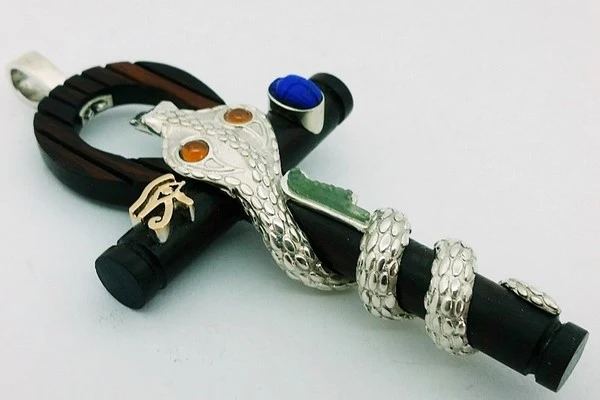
As shown in the following example, this pendant shows an intertwining of manual carving work, digital modeling and casting and cutting of fine stones.
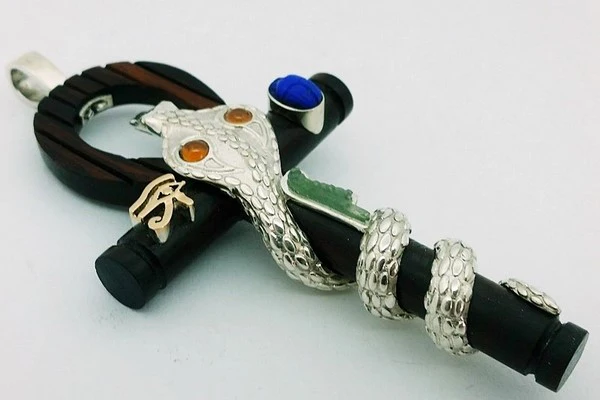
Example of jewelery showing the result of our personalized jewelery service. This pendant was custom created in our jewelry workshop.
We suggest you detail all the features here our jewelry workshop.
We do online quote for the realization of your jewelry projectsupon simple request via this form.
The evolution of the jeweler’s profession
The profession of the jeweler has existed for thousands of years, while that of the artisan jeweler is more recent.
Sceptres, royal crowns, princely jewels, and Roman or Egyptian seals were created by talented jewelers who had only hand tools at their disposal.
These processing techniques have lasted for centuries, some processes are thousands of years old, as in the case of lost wax casting.
Things changed during the 20th century with the arrival of electricity and motors that freed jewelers from more difficult tasks such as rolling plates or drawing wire.
Since the end of the 90s the situation has been upset by the advent of computers, numerical control machines for processing complex waxes and then by the appearance of 3D printing.
All these tools have done nothing but enrich and complicate the profession, making it even more attractive.
Nowadays, modern jewelry workshops (as is the case with the Vivalatina workshop) are both:
- a jewelry design center
- 3D printing of resin models
- a character atelier
- an ankle jewelery making workshop
- a stone cutting workshop
- a surface treatment laboratory (gilding and rhodium plating)
Tools for creativity
The anklet is this carved piece of wood common to all jewelers in the world.
It is still used by all jewelers to make their jewelry.
Modern jewelry-making techniques are inspired by the tools and gestures learned from older generations of jewelers (for millennia).
It is enough to see the jewels displayed in museums to realize that the know-how of the ancient jewelers was impressive.
Reproduction of an old arm bracelet
Today the techniques continue, but they have adapted to modern tools making the work simpler, faster and more convenient.
IT and its opportunities: 3D printing
Modern workshops use computer-aided design (CAD) to model complex designs, modify them and adapt them to the customer’s wishes.
Exploded view of computer modeling of an Egyptian jewelry pendant
The IT tool and the various software it allows us to use allow us jewelers to provide virtual images of the finished jewelery prior to production, thus allowing us to give an accurate view of the jewelery to the customer before they have to make a financial commitment.
These computer files can then be used to produce complex parts using the 3D printing process.
3D printing thus allows you to obtain physical objects in resin by inheriting all the computing and modeling power of computers.
These objects are then used for processing into precious metals.
The traditional lost wax casting process
This very ancient process consists of creating a master goldsmith in wax to create a mold of refractory material into which our molten precious metal (silver, gold or platinum) will be poured.
In ancient times the master was made with a mixture of beeswax and sawdust while the plaster was made with earth or any other available refractory material.
If today the materials have changed, the principle always remains the same and allows you to obtain pieces faithful to the original piece in resin or wax.
Our resin master gives us a graceful silver snake after casting
The size of the stones and their setting
The cutting of the stones is usually carried out by the stone cutter while the jeweler is responsible for setting the stones on precious metal jewellery.
The lapidary is responsible for cutting faceted stones into the sizes and shapes necessary for the production of jewelry.
When it comes to a fine stone cabochon, the jeweler can cut them himself.
Scarab carved from a lapis lazuli stone
Onyx stone cut into cabochon for the creation of this ring
This video shows the steps to cut this natural onyx stone:
Setting consists of forming claws in the metal, claws that trap the stones so that they can no longer move, even in the event of impacts and rubbing.
Working with wood and organic materials
Depending on your projects, you may need to work with organic materials.
These are most often:
- the wood
- skin
- the pearls
- the coral
- mother of pearl, abalone and spondylo
Woodworking is relatively simple compared to the rest.
Carved wooden shapes should blend seamlessly with the metal surrounding them.
Bead work is very non-technical and involves drilling and fixing.
Here is an overview of other jewelry creations:
To go further:
latest posts published

Moonstone in jewelry

Engraving of men’s signet rings
Diamond clarity: inventory of natural inclusions

Creation of a Chrisme Medal in 18K Gold

18k gold men’s necklace (handcrafted)

Large 18k solid gold bracelet

18k gold chain pendant

the history and symbols behind the Mo signet ring

Rolex: a brand that has become essential
