
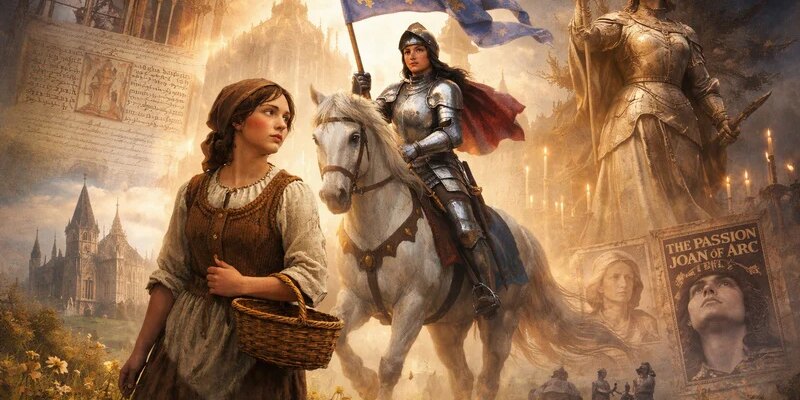
Born at the beginning of the 15th century in a village in Lorraine, from a peasant background without particular privileges, Joan of Arc was not destined to occupy a singular place in the history of France. His action takes place in the precise context of the Hundred Years’ War and his career spans only a few years. However, its name spans the centuries.
Over time, his story has gone beyond the French sphere to inspire writers, directors and historians in Europe, America and beyond, to the point that his name and image can be found today in works, university studies and monuments on several continents.
How to explain that such a short existence has acquired such meaning? A shift occurs between the Joan of Arc attested by historical sources and the symbolic figure constructed by collective memory which transforms a historical character into a universal point of reference. This article aims to examine this passage, rigorously distinguishing between consolidated history and the imagination that has gradually become attached to it.
AI-generated image showing Joan of Arc as a universal symbol, who became a saint for the Catholic Church and influenced the arts beyond French borders
INDEX
- An extraordinary trajectory in a codified world
- From historical figure to collective symbol
- The universal values embodied by Joan of Arc
- A figure adopted beyond borders
- Between history, faith and imagination: a malleable figure
- Because his image still stands the test of time
1. An extraordinary trajectory in a codified world
It was in the spring of 1429, at the castle of Chinon, that Joan of Arc entered the political sphere of the kingdom for the first time. Received by the dauphin, the future Charles VII, she claimed to be sent to «have the king crowned» and contribute to the recovery of the kingdom. This meeting constitutes much more than an anecdotal episode: it is the prelude to the subsequent ruptures that will mark his path, as we have developed in our complete analysis of the history and legacy of Joan of Arc.
In the society of the 15th century, strongly structured by birth and feudal hierarchy, access to the sovereign was strictly codified. However, Jeanne comes from a peasant background, without a title or noble network. His admission to the dolphin immediately breaks the relationship social birth codewhich reserves political influence for established lineages. This irruption into a space reserved for the aristocracy constitutes a first transgression.
The rupture continues in the military. War is then a male universe, a monopoly of the nobility of weapons. However, a few weeks after Chinon, Joan donned armor and accompanied the troops towards Orléans. If he does not formally command operations, his visible presence on the ground shakes the system military code which excludes women from combat.
It also crosses a religious line. In a society where spiritual authority is framed by the Church, it claims to receive heavenly voices and act according to a divine mandate. This personal statement, applied to an important political decision (the coronation of the king), tests the religious code that separates private inspiration and institutional authority.
Wearing men’s clothes adds an extra dimension. In the Middle Ages, clothing expressed the social and symbolic order. By adopting a man’s suit, Jeanne violates a dress code and gender which will then be used against her during the trial.
Finally, by supporting the legitimacy of the dolphin and accompanying him until the coronation in Reims, he intervenes in the delicate field of sovereignty. Without claiming power for herself, she acts as a mediator between God and the king, thus influencing the political code of dynastic legitimacy.
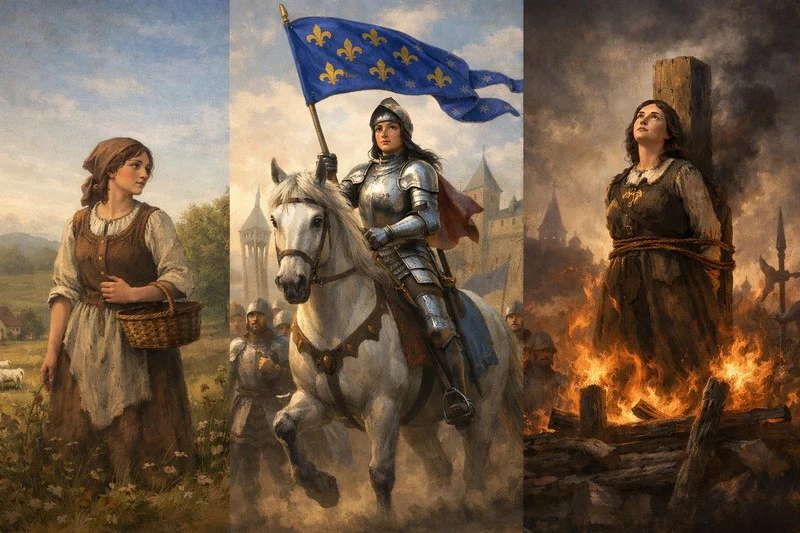
AI generated image showing Joan of Arc’s humble origins as a peasant on the left, in the center in armor on horseback holding the standard of King Charles VII and on the right Joan at the stake in Rouen, 30 May 1431
Jeanne’s appearance in Chinon is therefore not just the beginning of a military mission. It marks the arrival on the scene of a figure who, in a few months, concentrates a series of social, religious and political ruptures in a deeply codified world. It is this clash between a young girl without institutional power and the established order that establishes the singularity of her destiny and prepares the subsequent transformation of her story into a symbol.
2. From historical character to collective symbol
If Joan of Arc’s path is anchored to the events of 1429-1431, her transformation into a symbol developed gradually. It is based in particular on the exceptional abundance of archives of his trial in 1431 and his rehabilitation in 1455-1456, which have durably established his history. Paradoxically, the proceedings intended to condemn her contributed to ensuring her posterity.
The official rehabilitation, twenty-five years after his death, marks a fundamental step. It restores Jeanne’s political and moral legitimacy, annulling the sentence pronounced in Rouen. This gesture does not erase the violence of her end, but transforms her image: from condemned for heresy, she becomes the victim of an injustice. This inversion constitutes an important symbolic pivot.
Over the centuries its image continues to evolve. Chroniclers, then historians, present her from time to time as a military heroine, an inspired virgin, an instrument of providence or a figure of national recovery. Each era rereads its own journey in the light of its own concerns. This phenomenon of rereading does not erase the established facts, but modifies their symbolic meaning, as we have demonstrated by distinguishing what established the story and what built the myth.
Photo showing the canonization ceremony of Joan of Arc on 16 May 1920 by Pope Benedict XV
The canonization in 1920 by Pope Benedict XV added a universal dimension to this memorial construction. Joan ceased to be just a character in French history to become a saint recognized by the Catholic Church on a global scale. His name then enters the liturgical calendar and his image spreads far beyond national borders.
Therefore, the transition from historical character to collective symbol is neither a sudden myth nor a late invention. It is based on exceptional documentation, institutional decisions and a succession of cultural reinterpretations. History provides the foundation; collective memory shapes its meaning. It is in this space, between archive and imagination, that the universal figure of Joan of Arc is constructed.
3. The universal values embodied by Joan of Arc
If Joan of Arc continues to resist over the centuries, it is not only because of the events in which she participated. His destiny concentrates a set of values that go beyond the context of the 15th century and are aimed at societies very different from his own.
The first is that of courage in the face of adversity. Jeanne intervenes at a time when the kingdom is weakened and where the outcome of the conflict seems uncertain, in a political and military framework that we have analyzed through the historical context and the problems of the 15th century. His determination, attested by sources, is expressed both on the battlefield and during the trial. This consistency in the test fuels an image of moral firmness that goes beyond the strictly military sphere.
The second is the loyalty to an intimate conviction. Whether or not one adheres to the spiritual dimension that it claims, the fact remains that it acts consistently with what it claims to be its mission. This coherence between word and action, maintained even during interrogations, constitutes a powerful source of his symbolic legacy.
Jeanne also embodies a form ofcommitment to the service of an ideal that surpasses it. He seeks neither wealth nor personal power; his action is presented as oriented towards restoring an order that he considers legitimate. This orientation towards the common good, as she sees it, contributes to the exemplary dimension of her career.
Image representing the values embodied by Joan of Arc
Well, that youth plays a central role in the reception of his story. He was about seventeen at the time of the decisive events and introduced an unexpected figure into the political and military sphere. The encounter between young people and great responsibilities reinforces the universal scope of its story.
These values are not specific to an era or a nation. They partly explain why the figure of Joan of Arc can be reinterpreted in different cultural contexts, without losing its historical anchorage.
4. A figure adopted beyond borders
The story of Joan of Arc took place in a very short time and in a relatively limited geographical context. Yet, his figure spans the centuries and has crossed borders to make himself known in many countries.
Outside the French context, the figure of Joan of Arc has established itself in various cultural spaces. In 1896the American writer Mark Twain public Personal memories of Joan of Arccontributing to its diffusion in the English-speaking world. In 1923the Irish playwright George Bernard Shaw offers with Saint Joan a modern and intellectual reading of his destiny, quickly represented on numerous international stages. Cinema also participates in this global recognition: in 1928, The Passion of Joan of Arcdirected by Carl Theodor Dreyer, it became an important work of silent cinema, studied in film schools around the world. Finally, his canonization 1920 par Benedict XV definitively inscribes his name in the universal calendar of the Catholic Church, consecrating a spiritual dimension that goes beyond national borders.
On the left, the poster of the film The Passion of Joan of Arc, directed by Carl Theodor Dreyer. On the right, the cover of the book Personal Recollections of Joan of Arc by Mark Twain
5. Between history, faith and imagination: a malleable figure
The posterity of Joan of Arc it is based not only on known facts, but on how his fate has been reinterpreted over time. The archives of her trial provide a solid historical foundation, but each era emphasizes a different dimension: military heroine, spiritual figure, martyr or moral symbol.
The strength of his image lies in his interpretations which oscillate between documented history and experience of faith. Joan of Arc thus remains a precise figure in the sources, but open in her meaning, which explains the permanence of her presence in the collective memory.
6. Because his image still stands the test of time
Beyond historical analyses, Joan of Arc’s permanence is also explained by our attraction to powerful stories. Modern societies, like ancient ones, are marked by stories of ascension, mission, trial and tragedy; the same mechanisms we find in cinema or action novels.
However, Jeanne’s fate brings together all these elements: modest origin, war context, clear mission, opposition, trial and dramatic end, followed by rehabilitation. The strength of this story lies in a rare peculiarity: it has the structure of a great dramatic fresco despite being based on historically attested facts. This alliance between narrative intensity and reality largely explains the longevity of his image.
About the author
Nicolas Tranchant, entrepreneur and founder of Vivalatina, is interested in how some historical figures become lasting symbols. His approach combines cultural intuition and reflection on the transmission of values through memory objects.
latest posts published

Moonstone in jewelry

Engraving of men’s signet rings

Diamond clarity: inventory of natural inclusions

Creation of a Chrisme Medal in 18K Gold

18k gold men’s necklace (handcrafted)

Large 18k solid gold bracelet

18k gold chain pendant

the history and symbols behind the Mo signet ring

Rolex: a brand that has become essential
